
043: INTERVIEW - Killdeer Trio
Wyatt Ambrose and Evan Jagels talk about Killdeer Trio's new album, 'Underground,' as well as composition, improvisation, and what exactly is going on in rural Upstate New York.

“All three of us being professional musicians, we play a lot of different styles, and you have to, but this is our space to be completely who we are musically.”
-Evan Jagels
“The easiest word to describe Killdeer is jazz, but that only tells part of the story. There are also elements of fusion, jam band music and indie rock.” I quote myself not because I think it’s profound or beautifully written, but because I just think it’s pretty accurate.
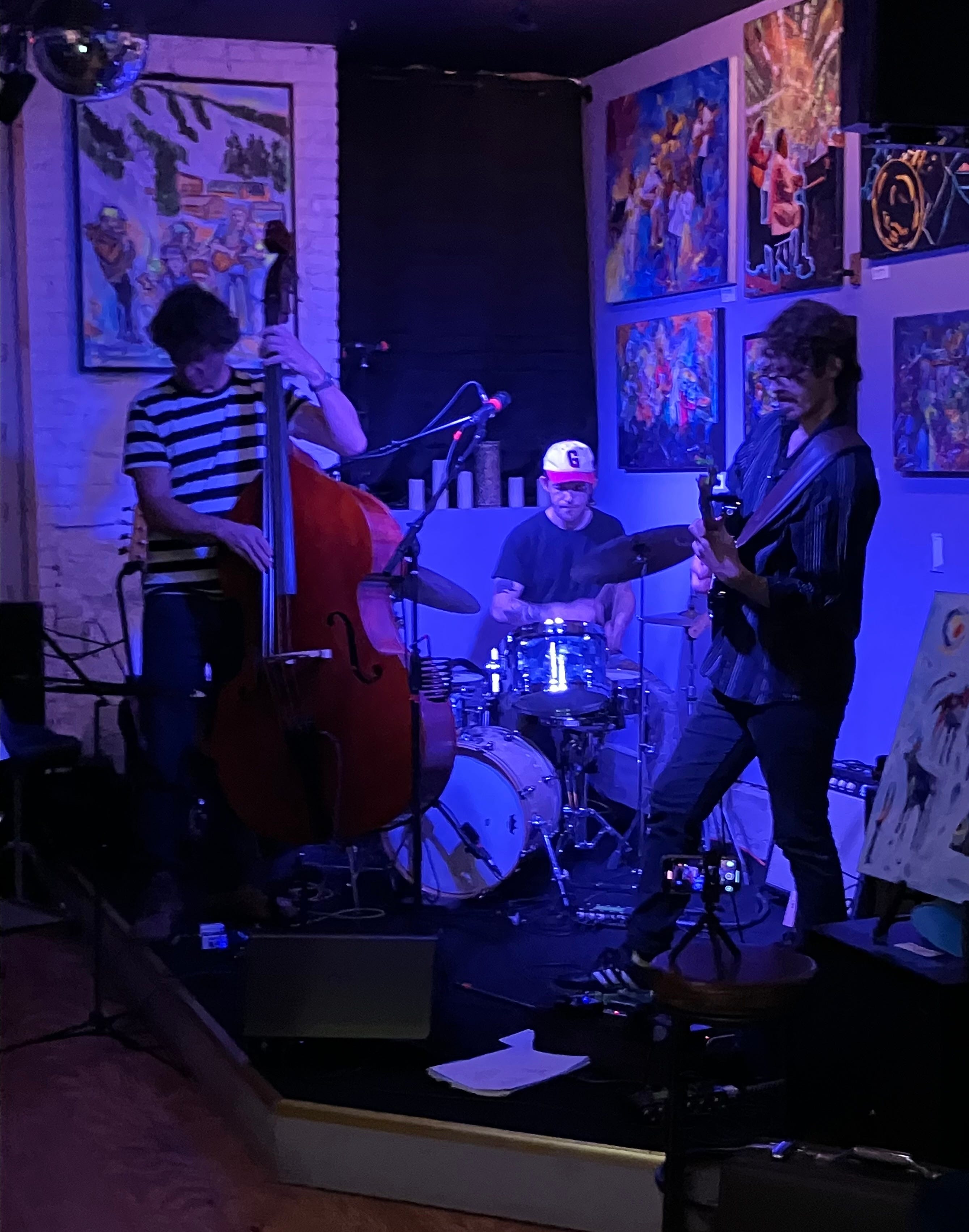
Killdeer Trio, based out of Oneonta, New York, just play music—good music—and that’s the whole goal. Comprised of guitarist Wyatt Ambrose, bassist Evan Jagels, and drummer Sebastian Green, the group defies easy categorization, and that’s because Killdeer is the outlet for them to let it all loose and not worry about existing within a style.
All three members play in a number of formats. To name just a few, Ambrose and Jagels have solo recordings and play jazzicized takes on Jimi Hendrix songs together with Blake Fleming (with whom Jagels is also in Dazzling Killmen), while Green plays indie rock with his band Leafing, amongst others. Ambrose and Jagels are also music educators at Hartwick college, having studied the jazz tradition in some of New York’s finest music programs.
It all plays a role in what the band does. It’s music that can be enjoyed by the casual listener, but also dissected and analyzed at the deepest levels. Ambrose and Jagels took the time to speak to me about it all. Their second record, Underground, is out now.
Let’s go all the way back—how did the three of you come together to form this band?
Evan: I met Wyatt probably around the same time I met Sebastian. I was playing in a band, like an outlaw country/Americana type band and Sebastian was playing drums, so I met him. Around that time, with a mutual friend of Wyatt and mine, we ended up car pooling to a Wayne Shorter concert at NJPAC. Wyatt was like 18 or something; I am a bit older. Wyatt was really mature, he was like, “Yeah, I don’t really get along with people my age, at my prom I found myself talking to the photographer the whole time.”
Wyatt: [laughs] I shouldn’t have asked you to go first.
Evan: I love watching you endure this. So anyway, we kind of hit it off and had a musical connection as far as mutual taste right away. It’s not a short ride to Newark and back, so we were talking a lot in the car, and i knew he was going to school at Oneonta for music. We started playing some standards together and then Wyatt went off to Purchase, which is a really, really excellent undergrad program. I think we stayed in touch and we always just kind of played in groups together when he was back here—blues and standards and stuff like that, but he had mentioned he has a metal background.
So, I’m doing this stuff with Sebastian, playing with Wyatt, and there’s all of these different influences we’re discussing and they become apparent. I don’t know exactly when Killdeer Trio started, but I had a musical connection with Wyatt and I had a musical connection with Sebastian—whatever type of music you’re playing, there’s a really strong connection with the bass and the drums, so we hit it off really well musically. I always felt super comfortable playing with him. Early on I could tell this guy’s got a really unique style for whatever type of music we’re playing. Obviously with that outlaw country stuff it’s kind of idiomatic playing within the style but I could tell he’s got a lot more going on than just this, not to disparage playing people’s songs. I could tell there was a lot more creativity there.
At a certain point we started playing, the three of us. We wanted to create an outlet for original music, and ever since the beginning, the outlook we always had was we’re not playing any kind of music, we’re just writing and playing the music that comes most naturally to us, and what is truly our voice musically. All three of us being professional musicians, we play a lot of different styles, and you have to, but this is our space to be completely who we are musically.
Wyatt: I think we first got together in 2022. The three of us had linked up maybe on one or two gigs for other people, but Evan and I had started working together more in duo formats and trios, mostly playing jazz standards and other things. I went to SUNY Purchase and tried to dig deeper into the jazz tradition. Around the time that we were talking about doing original music, I was thinking that I wanted to find a new voice for my own writing and I didn’t know what to call it exactly, whether it was really jazz or something else. I was just writing this music and I don’t know what exactly to do with this, but I know Evan can do this kind of thing that I’m thinking about, and Evan was like, “Sebastian can totally do this type of thing.”
We just got together and I brought music that I had been wanting to play, but kind of unsuccessfully, and Evan brought a couple tunes in as well. And we also just improvised and just played some total free improvised stuff, and it was definitely apparent immediately. I would put it like that first meeting was like, this is the music that I’ve wanted to make since I was 17 or 18, but now I’ve gone through the avenues of actually being able to play it, having the skill and the sensibility to at least start figuring it out. I think through that it became what it is, this transition of my own thing through this new collaboration.
It’s interesting that you guys have all these other different styles that you can and do play—what was the path for each of you to get into this world of jazz music?
Evan: For me it was the music I was exposed to a lot when I was really little. My dad has a really, really vast record collection that he categorized alphabetically and by genre. He showed me how to use the record player and how to take care of the records and let me have at it. I really gravitated toward like Pharoah Sanders and John Coltrane and some really out stuff the most. I remember being young enough, my reaction was to roll on the floor and laugh when I heard music that was that free, and it just resonated with me. There’s was always a piano in the house and I had taken piano lessons and I was trying to teach myself to be better. Anytime I found any sheet music I would hoard it and I would figure it out on piano. I would work so hard on not practicing what I was supposed to practice for my piano lessons and just do whatever stuff. There was an early Joshua Redman album and I figured out a line and this whole door opened up, like, “Oh shit, you can just figure out what the notes are and just play them.” That was my entry to transcribing. Before I was a very good reader, I was transcribing stuff.
I played trumpet in band, so I was always around jazz and playing, and then I ended up in undergrad working a lot in New York City with some really older people. That was really formative for me and I learned a lot. They started the group with Jimmy Knepper, who was Charles Mingus’ trombonist and did a lot of his arranging. There’s a famous story about Mingus where he was like, “I need these arrangements right now,” and Jimmy Knepper was like, “F you, you’re taking all the credit, you do it,” so Mingus punched him and knocked all his teeth out. He couldn’t really play with him anymore so he started this group with these older guys and I started playing with them.
I went to grad school at Queens College for jazz and was always in that world. I love the history and the culture and the vocabulary and the songbook and the standards and the tradition, and I still do, and I still play it and love playing it, but even studying it at that level, I never felt one hundred percent in. That’s not my experience, but it’s always been a part of who I am playing. After undergrad, before graduate school, I lived in Germany and I was playing there and touring around Europe, and I got exposed to a lot more forward-thinking improvised music. What they call jazz is really different than what we think of with jazz. That opened me up a lot, and I always felt like this is getting to more where I feel at home. It progressed from there. I wrote this sappy text to everyone the other day, but I really am so thankful to have this group and to be able to have a place where it’s just our voice.
Wyatt: First I’ll say, Mr. Jagels is a pretty serious guy when it comes to music appreciation. I remember when we started this group he was like, “This is my favorite thing that Evan is doing right now so you can’t really do any wrong, but you should still try.” [Laughs] I was like, “All right. Thanks, Rick.”
But yeah, it’s interesting, my parents are not really musically inclined and aren’t super into music, but I think that one way that I sort of mirrored my mom early on was that she was really into a couple albums. She loved Dark Side of the Moon and Wish You Were Here, so we listened to that all the time. She also loved “Girls Just Wanna Have Fun” by Cyndi Lauper, which I didn’t like as much. But I think that idea of having this record, from my dad it was AC/DC Back in Black, and that lived in the car. Then my step dad introduced me to The Beatles and that was a big thing.
I think for me, I got a guitar when I was 10 or 11 and I got really into it, the instrument and the sound. I remember really early on, I would learn songs but then I would also write my own little songs and taught myself how to play that way. I think that approach carried me through, then my step brother played bass and was really into metal, so he showed me Lamb of God and Mastodon. He was playing in bands already and I got really into heavy metal—but in this way of isolated artists really speaking to me and I would get obsessed.
I think at a certain point I felt like I was committing to music and pursued lessons with people who I thought could teach me more about music in general, and those people led me to jazz I think. I remember having a guitar teacher who was like, “Have you heard ‘Bright Size Life’ by Pat Metheny? We should learn how to play that tune,” and then I’d listen to it and it’s amazing. We were having a conversation, like Evan was saying, and I’m really grateful that the three of us are close in proximity and had similar experiences, but I was talking about how at a certain point I was listening to Meshuggah, particularly the song “Bleed.” You know that crazy rhythmic thing, but I was also listening to this early album by Mark Guiliana and a band called Heernt—it’s drums keyboard and saxophone, maybe bass—and the way it starts off is him playing a typewriter in rhythms and I was like, “Oh, that’s like the same thing Meshuggah is doing. Oh shit, you could do that.” From there, someone told me to check out a jazz jam session and I would check that out while I was still playing in my metal band and recording with them.
So for me it was like, Tosin Abasi [Animals As Leaders] is clearly in the same world as Allan Holdsworth [Soft Machine] and Allan Holdsworth is influenced by John Coltrane and all these people. Then someone shows me Kurt Rosenwinkle [Human Feel] and then it all turns out that they all dig each other too. That’s how I got into it, but I think at a certain point I thought I have to learn about jazz in a more genuine way I hit this point where I was like, “If I’m going to do this I have to go all in,” and I kind of stopped playing all this stuff, metal in particular, I just kind of made a clean break. Like, “I want to be as good as those guys at improvising and I’m not going to be able to do that unless I fully jump in.” So I’m glad I did that, but I also had to kind of reel my way out. That’s sort of the long journey.
So when the three of you do first get in the room and start playing, were there discussions or conscious decisions to make Killdeer as open to other things outside of jazz as it ended up?
Wyatt: I think it was more like we just talked about music and then that’s what happened. In rehearsals a lot of time you’re talking about music in general and then talking about what you just played, and I think maybe it’s just serendipity. We didn’t have to be like, “We’re not doing this,” but we probably said at some point, “I don’t want to just sound like another jazz guitar trio.”
Evan: I even feel like as we’re playing, especially in a free improv situation or were trying out different compositions before we really had it cohesively together, you could kind of feel where it really hits and where it really feels natural and comfortable for the group. We tried some things that, and I know Wyatt does this and I do it too, but you write something and it’s like, “This is not great for Killdeer Trio.” But for me that’s never a decision until after it’s done. The longer we’re at it, the more clear something becomes.
When you’re composing a piece can you sort of hear what each of the other members might bring to it?
Wyatt: Like Evan was saying, I think at this point, maybe after this second album of ours, now when I’m writing music—we are working on some new stuff—it’s like, “Oh yeah, this is a Killdeer Trio thing.” I would say I can hear that they will do something that only they will do, but I think that’s a big asset of both Evan and Sebastian is that I really don’t know what they’re going to do. I know they’re going to do something great and I really genuinely don’t know what they’re going to do. Even if I say, “I’m hearing this kind of thing,” they’ll come up with some cooler ten times out of ten.
Evan: I’ve had that experience. Let me start by saying, when you’re improvising there’s so much trust that has to be there. Like having any conversation, I’ll tell pretty quickly if you don’t speak English and then we can’t really communicate. But there’s so much trust that goes into it and I completely trust them. Early on I was maybe thinking, “I want the drums to do this and the guitar to do this,” but now when I write, it’s just a line and I bring it to them—I don’t even put chords on some of this stuff—and I can’t wait to hear what they do because I know it’s going to be great and going to be something that I couldn’t conceive because I don’t play those instruments.
It used to really annoy me, especially in grad school and even playing in groups in New York City, when they would write these dumbass bass lines on something. It’s like, why don’t you trust the bass player to play something? I’m just playing this line and thinking of all the ways it could be better but they wrote that line specifically, so I gotta play that.
Music with a lot of improvisation is something that I listen to a lot of, but I struggle to understand the physical and mental abilities it takes to interact in that manner. What’s that process like for you two—is there conscious awareness of where you’re going to go, or is everything a reaction to everything else you’re hearing? How does that all unfold?
Wyatt: Well, that is the mystery, isn’t it?
Evan: It’s the same exact way that this interview is happening. You have questions, stuff written down, we’re going to get to them, and we each create space to go in other places. None of us has a script other than the loose form—questions. It’s kind of like that. I love each time not knowing exactly where it’s going. The form is going to be the same more or less, unless it’s a truly open section like “Converging Divergence.” There’s loose rules but it can be different every time; same elements that go into a conversation.
Wyatt: I think it kind of is the ideal situation because we’ve now played together so much and trust each other and have also played the material. There’s the written stuff that makes up the song, to use the analogy the written question, we’re going to start there, but I think that when it comes to the improvised sections we’re at a point where I think it really does feel like we’re improvising together. I was playing a concert like two years ago and I was playing some original music I had written for my recent album, Up There, that I did with a different quartet and I was playing with musicians who weren’t on the album. We didn’t really rehearse, we just went to the gig like an hour early and played through a couple things just so we didn’t totally mess up. One of the people doing the concert was like, “How do you do that?” This person is a musician, a singer/songwriter, and she’s just like, “I just don’t understand how you do that; that’s amazing. It’s literally magic.”
So I feel like after that, having a conversation like this, I think there is something kind of inexplicable about how that works. The best way I can describe it is that you’re just listening really, really hard and really trying to play as if you are listening to the music as it’s happening rather than directing it. I think on a kind of more tangible level, I think I am just trying to hear what Evan and Sebastian are doing and then play with that and add or maybe suggest from there, just as in a conversation. But there really is a lot of it that is like, “I don’t know why I played that.” That’s more the mystery. I don’t know what brought the other people to this particular moment, but the moment’s now; let’s make the most of it.
I used to see a fair amount of free improvisational music when I lived in Connecticut and it was interesting to see the same players make different choices. I remember seeing Joe Morris with a lot of people and often he was very intense and maybe aggressive sounding, but when I saw him with Anthony Braxton he sort of pulled back. I wasn’t sure if it was for the audience, to really let Braxton shine, or if he was a little more subdued because Braxton was more melodic in nature than say Evan Parker.
Wyatt: People talk about the analogy in improvised music of people’s personalities coming through or maybe coming through in unexpected ways. I think free improvisation, the one personality trait that becomes apparent really clearly is how giving someone maybe is [laughs]. Or how open they are to not leading the show, kind of letting go of some of your own ego, or however you want to talk about it. I think that’s why a lot of times, people who have really strong personalities who really need to lead things, or maybe sound best doing that, at least in my experience, they’re not really that fun to play fully improvised music with. Probably that’s the thing, especially someone like Anthony Braxton who is a pioneer of that kind of music, he’s thought a lot about how it can work. Probably if I was playing with Anthony Braxton I would be more interested in hearing what he had to say or where he was going to bring us, and then trust my own instincts, I suppose.
With you guys specifically, a song like “Quatrane” sounds different every time I hear you play it.
Evan: I think starting it with an open bass solo, I think whatever kind of mood I’m in is going to dictate what course that takes. It kind of sets it up. I think that’s the only one that starts with an open bass solo.
Wyatt: I think that with something like that, there’s a structure but it’s maybe more open than some of the other ones that we do. Also, starting with the open bass solo, I think that’s an asset of Evan, he’s always thinking about really trying something out. Starting there with trying something he hasn’t done or a variation, and really being committed to that aspect of the creative craft, which I certainly feel like I feed off of. I think one thing that we were talking about at one point is that we do try to latch onto that energy of trying to surprise the other people sometimes. “Quatrane,” I’m pretty sure that was one of the first songs that we played together in one of our first rehearsal jam session things. I think for us it’s like, how different can we make this just to keep us interested rather than feeling like we’re preserving?
You’ve mentioned that this record sounds closer to what you guys sound like live than the first one does, which I agree with. Can you talk about that evolution for the group?
Evan: How many years was it between them, two years? We are much more comfortable with each other. Knowing Wyatt and Sebastian, and me, hopefully I know me a little bit, I think we’re all better musicians than we were two years ago. Sebastian, I know, practices an insane amount; really a lot. Wyatt does too, and so do I. Just because you get to a certain level doesn’t mean you’re at that level, it means you got to that level at that moment and you can go back down. I’m sure we’ve all had experiences of seeing some master from a while ago and it’s like, “Oh no, they’re not that good.” You don’t want that to be the case, but you can regress, and we all work really hard at our instruments, and also in a lot new, different musical situations.
Doing new projects outside of the group; it’s kind of like you’re in this family unit and you go outside and experience something else and then you come back home and bring some of that culture with you. I can’t deny that learning all the Dazzling Killmen stuff and playing that has affected the way I play this. We all have other projects that we do, and doing those things and then bringing it back. To bring it back to where we started, that’s who we are and this group is really coming from an honest and pure space. There’s no denying the influences of those other great experiences. I think all of that is reflected on this album. Also, I think we’re happier with the actual sound of the recording. Between the two recordings I started using gut strings, and we’ve all gone through some different setups with our instruments which I think is better suited to the music and also better captured on this recording.
Wyatt: That’s all absolutely a part of it and I think a very important part of it, but I think the condensed version is just that we sort of became the band that we were trying to become and it took that time. I think that recording the first album was like—I’ve used this analogy before—it sort of opened the door to this creative project. We had only been rehearsing and playing for a few months and we were really excited about it. I think we had tapped into something, for sure, but I’m sure if we recorded that album again, I’m not going to say it would better, but I think it would be really different.
For instance, the second song on the new album, “Coming To,” that was also a really early Killdeer Trio song. We just happened to not choose to record that, I don’t even know why, but it became so much cooler of a thing to all of us. I don’t know when that happened within that two years, but if we didn’t do that it probably would have never become what it was going to become. I think for me, this experience has been a lesson in the value of patience and letting something grow, and putting in that work to reach that next level, and then you can make greater choices from there. I think that this album is the result of being able to make choices rather than just doing what we were able to do at the time.
Evan: I think “Coming To” is a really good example because that’s one that we played early and that’s one that is on this album that we still play, and that’s one that has a written out bassline that doesn’t suck. It’s a great bassline. The way my approach has evolved with something like that is, here’s a cool line, there’s a definite set of chords to it, it’s outlining this chord and this is the line, but it was only up until recently that it was like, “Okay, I know the chord, I know the line, I know the notes that are in that chord,” but that’s not what I’m thinking when we get into improvising. I’m thinking, “What’s the feeling that this chord gives? How do I explore that feeling more?” A lot of that feeling is the notes of the chord, but I could also get that same feeling with notes that aren’t even related to that, and that is something that can bring an improvisation in a new direction and is a way of approaching harmony that is kind of newer for me.
You guys are well versed in theory and composition, you’re educators of music and have a vast knowledge of these things—I’m curious if the composition for these songs starts more from an idea in that more intellectual side or if there is still a lot of messing around and finding a set of notes that sounds cool on the fretboard and building off that.
Wyatt: Maybe both.
Evan: They’re going to be different answers probably and that’s because talking about a compositional process everyone is going to be different. It would probably be different if you had a full time job that was to compose music and you had to put out a certain amount of things and you’re responsible for that. But for me improvisation and composition are the same thing, but one is slowed down and you can make edits, and that’s when we write a piece. I improvise every day as part of my practice and when something just resonates with me in a way then it’s like a spark and an ember starts. Then it’s having the patience to write it down and work it out and see it through to a thing that can be handed to someone. That’s where all of my compositions come from.
Wyatt: I do think, especially after the first album, I really tried to approach writing for this group in a different way. When we started out it was like, well, we need some music to play. “Coming To,” I actually called it that because I kind of had writer’s block during the pandemic. I was going through some heavier family things and relocating in a way that I wasn’t really expecting, and I had been writing a lot of music the last few years of college, but I was really not writing anything. That tune did just kind of come out with that bassline. I kind of thought it could be a metal riff if I played it with distortion. A lot of music was coming out all of the sudden—I think being inspired by these guys, too—and I was trying not to overthink it. I think it also coincided with a shift where I wanted to find a different voice. Sometimes I’ll be thinking of something like, “What if that did exist, what would that sound like?” Rather than force it, I try to imagine it, if that makes sense.
Composition is something I’ve thought about a lot, and I do think of improvisation and composition as the same thing. I’ve spent a lot of time also thinking about the craft and I’ve taken some classes and private lessons with composers just because I’ve been like, “How do they think about it?” Like when they have the eraser, how do you make those decisions? “Converging Divergence” was a melody that came to me walking my dog, and that happens a lot. I’ll just be in the shower or doing dishes or I’m late for class, and then I’m later for class because I’m hearing something and want to figure it out. I think after that first album of letting everything come out and not overthinking it, I think I went through a period of writing a lot of things and trying to edit.
It’s a blend of the two. I think now it feels more organic. I think my best music is some kind of combination of hearing some melody and trying to figure it out and stumbling upon something. The riff to “Underground” was me just playing some chord shapes on guitar like, “i don’t know exactly what that is, but let’s see.” Like, people imagine that 7/4 groove was probably thought out, and then it switches to 6 and then goes back to 4. That’s the sort of thing I might have programmed into Guitar Pro when I was 16, but that was totally organic. I did not plan that out until I was like, “I have to write this out so we can play it.” I don’t even know if I did write that one out for these guys; I think we did just play that.
I try to find the balance; I don’t want to overthink stuff, but I also don’t want to under-think it. For this group I definitely try to bring things in that are not finished. Like, if I write a song I’m going to bring it in when it’s maybe seventy percent there. Like, we can play it, but definitely not enough that I fully have this vision. I want to give them room to think of something, again, because I don’t know what they’re going to do but it’s going to be good, and then it will be a Killdeer song, it won’t just be a Wyatt Ambrose composition.
Being music educators, does the lesson plan or the particular topic you are working on for class play a role into your thinking for writing music?
Wyatt: I would say the opposite. I would say the other way around where I’m doing something and I’m like, “You know, I should tell them about that.” Definitely connected, I think so. Everything is connected, it’s hard to not feel like you want to share some knowledge that you feel like you found, especially if you think it would be helpful for somebody else.
Evan: Yeah, absolutely. “1031” I wrote at the college. It was a long day and I was just at the piano. I can’t just go from teaching to go home and do stuff, I have to decompress a little. Luckily, working in a music department there’s a lot of opportunity—there’s a grand piano. I can sit there and just wind down a little before I go and do the next thing. That song came in that space.
It is all connected and I get excited about sharing things with students and I always look at it like we’re all in this together. I want to try to help people be able to teach themselves. I look at the greatest lessons I had, they were lessons from bass players that will last me—like a concept I understood very easily and, at the same time, something I can work on for the rest of my life and never get perfect. I try to get those things to people. Trying to build a community of self-actualizing engaged musicians helps everybody.
The area that you guys are from is sort of surprisingly active for music. It’s these little rural towns, but I always see you are up to stuff whether it is with Killdeer or any number of other things that you are involved in. Is that related to the colleges out there?
Wyatt: I think Evan is one culprit in the reasons why that’s true.
Evan: I don’t want to go to the city so I just make happen here what I would want to go to. I realize it when I travel to other places, there’s really a lot of arts happening in this area. I think it’s very special and if I didn’t leave I wouldn’t know that. Maybe I’d think the opposite. But when you go to a lot of places it’s like, “This is a city, where’s the stuff? What’s happening here?” We definitely don’t suffer from that.
There’s a rich history where Sebastian’s from in Cherry Valley. Allen Ginsberg lived there, members of The Grateful Dead, the beat poets, the great pianist Paul Bley. There’s a great tradition there and there just seems to be a lot in Oneonta as well, and Cooperstown. There’s the Glimmerglass Opera and like three separate concert series in a town of under 2,000 residents that has world renowned international acts. It’s pretty special. That’s not without influence on Killdeer Trio, being from that type of environment. Those three towns are pretty happening compared to other places their size, and it seems to be going in a good direction.
Wyatt: I think the real key part of it is that there is, in this small little area, a lot of people, which is like a couple dozen people, who just work incredibly hard and care so much about keeping things happening. The history, anywhere you look, goes back pretty far. Oneonta, our trademark was that it was a railroad town. The biggest roundhouse was in Oneonta so it blew up around that. We have this theater that is one of the biggest theaters in New York State, the Oneonta Theater. Unfortunately it hasn’t been open in a number of years, but growing up here, there’s two colleges—Hartwick, where we work, and SUNY Oneonta—every weekend there would be college bands playing at one of the bars and/or at the theater, there would be national level acts.
A formative experience was seeing the Branford Marsalis Quartet play at Foothills, which is a big performing arts center, and the executive director of Foothills. Jeff Doyle, is incredible. He works ridiculously hard keeping the doors open at that place. It’s just a lot people who really care a lot and know what the history is and want to maintain it. I think Evan is more involved in producing shows than I am but I try to help where I can and do what I can—I serve on the Foothills board of directors now and do the little that I can manage.
But I think as educators, rather than just teaching my students, I want them to be excited about music and have things for them to do, so I want to play here. We started a Hartwick jazz thing a couple years ago, having guest stars here. I want people to have that experience that I had seeing Branford Marsalis, and the Ron Carter Trio with Russell Malone. Incredible guitarist, deeply influential to me. I saw him before I had any idea what he was doing. I don’t know why the area is like that, but it certainly is that way.
What is your favorite song on Underground and why?
Evan: This is like asking someone which kid is their favorite.
Wyatt: That’s easy.
Evan: They probably do haver a favorite and never say it. I’ll say maybe “Underground,” and just as a reason to be able to say that, to bring it back to improvisation and stuff—well, first of all, the writing in that is so spectacular. That whole thing that Wyatt did moving shapes around on a guitar and it came to that, it’s just such a beautifully written chord melody that’s got such a unique groove to it, and then when we get into the improv section, what makes that unique and what makes that stand out for this question is that so much with improvisation you’re thinking of harmony and melody as the shapes you’re working with, but from the drum and bass perspective, harmonically I don’t really venture out, it’s the same the whole time, but where Sebastian and I are improvising is in the time. To be able to keep a groove yet improvise time signatures, because we don’t think of that in terms of time. The song is in 7 and there’s a part in 6, but when we get into that solo section, we drop thinking about time at all and there’s little hooks we come back to. You could listen to it and say, “Okay, this is 11 and then there’s 5 and there’s eight measures of 4,” but we’re just going off feeling and improvising a time while the harmony stays the same. To me, that’s just so exciting and so cool and really so well captured. I think we recorded that at the perfect time in the evolution of the piece to really capture that.
Wyatt: Well, you made a pretty good case for that one [laughs]. This is maybe a little bit of a copout, but I think my favorite recording on there is probably tied, either “1031” or “At the Mall.” “1031” was the first song that we recorded on the session and I think it’s the only take that we even did. I think we got some levels and we did it and we were like, “Oh my god, okay, don’t do it again.” I remember listening back to the mixes, and it’s the opening track on the album, so the day we released it I was listening back and listening to that track, and we talk about this whole thing of listening, and it just feels like we were so in the zone. Listening to it brings me into that zone. I kind of get a similar feeling with “At the Mall,” I don’t think we did more than one take on that either. Maybe two. That really feels like it that’s what Killdeer Trio sounds like. Like, we were just doing our thing and it happened to be recorded.
As far as the actual song, though, I feel like “Underground” is the most collaborative piece. The actual composition itself I feel like is maybe one of my favorite of ours, if not my favorite. I feel like there’s parts that Evan came up with that I did not write out, I gave him almost nothing, and I think Sebastian also, gave him almost nothing, and he’s got all these great ways of playing it. I know when we first started playing that, that was one of the earlier moments where I was like, “Okay, this is what this band sounds like.” Evan said the other day when we were rehearsing, “We’re like jazz for metalheads.” I might have written a metal song in 7 ten or twelve year ago and it could have been something similar but sound so different. This really feels like a full circle thing. How’s that for a bullshit response?
OFFICIAL UNOFFICIAL ENDORSEMENTS
In the ‘endorsements’ section of No Limit on the Words, the interviewees take a moment to officially unofficially endorse anything that they think is worth checking out.
Wyatt: “Political Science” by Randy Newman
I only became familiar with this recently because Randy Newman played it on John Mulaney’s show, Everybody’s Live. I was like, “What is this song, did he write this for 2025?” It’s from the ‘70s. Then I listened to that whole album Randy Newman is a very enigmatic person. The comedy, but really tongue-in-cheek, and he’s not doing anything different than he normal does—it’s just these goofy lyrics about everybody hating us and how we should just bomb everyone in the world. I kind of dig that way of being, like you can make a joke in music without it being a fart joke. That’s a funny thing to imagine and then follow through with. I want to do more of that sort of thing, and I think maybe we all should do that sort of thing.
Evan: Creating/engaging with meaningful art
Future me would be upset with myself if I didn’t mention this solo album I have coming out on December 12. [EDITOR’S NOTE: It’s out, and you should check it out]. It’s a project that is really personal; each of these compositions is born through an experience or a feeling or something attached to it, and there’s a story with every composition. I was struggling with wanting to record this solo album, but how do I share this experience, and I was getting so upset with how may people—not the people on this call, but normal people on the outside—engage with people and it’s such a passive thing. It seems to be just because they don’t like silence that much they’ll put something on, and it’s just so cheap. But how do I share this in a recorded format and keep people engaged? So I decided to collaborate with a visual artist, Timothy Atticus, who is the co-owner of this place where we play a lot called Gatehouse in Morris, NY. He’s a really accomplished artist, and he had seen me play a few times and I had seen him drawing a few times, so I asked him to do this. So, I wrote this book as I was playing the masters, and it’s the story of each piece and visual art.
That’s all for this edition. Thanks for reading. And thanks to Wyatt and Evan for taking the time to speak with me. If you enjoyed this share it with a friend!