
045: INTERVIEW - Cutthroat
RJ Pipino and Ryan Murphy talk about the ‘90s Albany hardcore band’s history as they gear up to reissue their pummeling 1995 full-length, ‘Hatebreedsrage.’

“If you listen to the songs, it’s pretty heavy, and then we try to outdo that part, and then we try to outdo that part. It’s just constant heaviness.”
-RJ Pipino
Heavy is certainly one word to describe ‘90s Albany hardcore bruisers, Cutthroat. Pummeling, brutal, and relentless also work. But they only touch on one aspect of the band’s identity: the hardness of each track. And while that is certainly present—particularly in the searing vocal delivery of frontman, Ryan Murphy—it leaves out the element of proficiency that helped to make them stand apart from anyone else playing hardcore music at the time.
That can be heard first and foremost in the riffs guitarist RJ Pipino was bringing to the band. Heavily informed by his thrash and death metal upbringing, Pipino’s style leaned more towards bands like Pantera and Sepultura, but filtered through his experience attending local hardcore shows in the early ‘90s. Coupled with a skillful rhythm section in drummer Eric Pearson and bassist Bryan Hart, Cutthroat walked the fine line of metal and hardcore, locking in on a sound of savage heaviness and mosh-inducing grooves.
Amongst a diverse and growing Albany hardcore scene that included such heavyweights as Stigmata, One King Down, Section 8 and Withstand, amongst others, Cutthroat became staples at the now legendary QE2 club where they could just as easily play with Killing Time as Crowbar. Their 1995 full-length, Hatebreedsrage, stands as one of the finest records from that era, one that still sounds heavy and aggressive even today.
With Pipino gearing up to release a reissue via his Wax Assault Records (preorder here), he and Murphy took the time to reflect on it all, and talk about what the future might have in store.
What was the access point for each of you to getting into underground music?
Ryan: To tell you the truth, what really got me into it was a kid, Matt O’Conner, I played hockey with. It was all New York hardcore and all crazy stuff. I got introduced to that early on in the hockey locker room with my buddies. That’s what got me into the whole hardcore thing. He was like, “Come on, we’ll go to a show,” so I went to my first show—I think I was 14 years old—down at the American Legion Hall in Albany. I can remember the lineup. This band called Snow White, Final Terror and Dead End.
RJ: They were local Troy bands, Dead End and Final Terror.
Ryan: Dead End kind of became Flat Broke; Final Terror were shredders, metal. Final Terror, Cranial Abuse shows were all the time back then. When we were younger we didn’t have the luxury of having a Ted Etoll and a QE2 and these venues, and you’d have to convince a venue to let us do it and then we’d do a show there and the venue would be like, “Never again.” I remember this guy, Don, he used to do all the shows. Shows back then were, you went over and printed off a bunch of hand-drawn flyers and had a bunch of skateboarders ride around Albany just handing them out everywhere—Music Shack, Worlds Records. That’s how they did shows; they didn’t have promotion. It was so underground, people didn’t even really know what the hell it was. It was cool; it was kind of like being in the underground cool club that nobody knew about.
RJ: It’s interesting too because my experience was a little different. I was a metal dude. I started out with Dokken, Motley Crüe, all that stuff—big into MTV starting to learn how to play guitar. I had aunts and cousins, all female, so they loved that stuff, but they all had boyfriends. They’d come over with racks of tapes—Slayer, Destruction, Nuclear Assault, all this thrash metal, and I’m consuming it like crazy. That’s how I got to the heavy underground stuff. My first concert was 1990, Motley Crüe Dr. Feelgood, and everybody was wearing Possessed shirts, showing they weren’t poseurs. That was a big thing back in the day, you didn’t want to be a poseur.
Ryan: That show was at RPI Fieldhouse with Whitesnake?
RJ: No, that was the one before. That was Girls, Girls, Girls.
Ryan: I went to that one.
RJ: I went to the one at Knickerbocker Arena, which I think is called MVP now. Faster Pussycat opened up. But a couple years later, my buddy Jesse was into hardcore. He gave me—and this is something really cool about Cutthroat—he handed me the Substance demo, which was Ryan’s second band. Dude, I loved it. I didn’t really know hardcore. What I knew of hardcore was Suicidal Tendencies, DRI, Excel, Mucky Pup, all the crossover bands. But he handed me the Substance demo and I loved Ryan’s voice and his lyrics. I loved the attitude and the simplicity of it compared to metal. It was just more raw and in your face. So, I started going to shows about 1992, years after Ryan. I was going to see Substance, Substance was going to play all these shows at these clubs and kept canceling. They would never show up. But Stigmata, Withstand and all these other local bands were playing. So that’s how I got into the hardcore scene. Then I met Ryan a year later in 1993 and that’s how it all started.
To Ryan’s point—PJ’s Club West was my first hardcore show and it was Substance, Withstand, Stigmata; they had two shows there and once they saw the mosh pit they were like, “Hell no, we’re not doing this again.” That’s how it was. Every time a place would open up and have a show they’d never do it again.
RJ, did you have bands before Cutthroat?
RJ: As a kid in grade school talent shows, playing metal songs, scaring the heck out of all the suburban parents seeing these long-haired kids playing King Diamond and Sacred Reich. Then I was in a band called Downfall, which was the members of Section 8 before Section 8. It was me, Tim Parent and Mike Watkajtys. I left Downfall to do what became Cutthroat and those guys ended up forming a band called Long Shot, which eventually turned into Section 8.
Ryan, I’m familiar with Substance, but you mentioned you had a band before that.
Ryan: My buddy Scott was drumming with these kids from Pittsfield [Massachusetts] and they got me to sing. I guess they were looking for some crazy kid and I was kind of crazy back in the day. It was like a straight edge hardcore band. That’s kind of what got the ball rolling for me. I didn’t really know nothing about singing and music or anything, but when I was a kid my father had a killer record collection. On the weekends it might be cartoons on Saturday, but I grew out of cartoons early because I found that box of records. It was like Black Sabbath, Jimi Hendrix, The Doors, Zeppelin, Iron Butterfly, Cream; pretty cool stuff. Stuff that back in the ‘70s was pushing boundaries. I was always into music and listening to it, but I went to Catholic school and never took music class or anything.
That was my first band; we had a lot of fun. The straight edge thing was fine, I was a young kid. If you’re straight edge now, I applaud it—it’s a good thing. Trust me, I know from experience. They were pushing the envelope with that and vegan stuff and I was just not into that. Me and this guy, George Armstrong—”Buddy”—he played in a lot of different things around here, he was in Stigmata for a while. He and I were bullshitting on the phone, and this kid Will Rice, he was a skater from Clifton Park, they were looking for a drummer. There was a kid I went to LaSalle [high school] with, Brock Evers—I think he and his brother were original members of Attica or something. He lived in Colonie and just kind of had a crazy double bass black pearl kit and, let me tell, you this kid could play. He was metal, which was different from the hardcore stuff. Add in that metal flavor with the hardcore dudes and we just were kind of going heavier. At that point in my life I was listening to a lot of Sheer Terror and stuff like that. That’s kind of how [Substance] happened and that was a lot of fun, but I went to college to play hockey and I knew I was leaving and I couldn’t do all that stuff, so I just kind of passed the torch to my friend Dan Craver. He did some 7-inches and RJ saw them. I kind of disappeared after that.
When my knee wasn’t really the same anymore, I came home and Bryan Hart, the bass player from Cutthroat, bugged the shit out of me. “Let’s start a band, dude.” I’m thinking, “It’s been three years, it’s in my past,” but he wouldn’t let it end. We got together a couple times with this guitar player and we found a drummer who was kind of crazy. He looked like David Koresh, he was kind of a hippie dude but he had a drum kit with double bass.
We were missing a guitar player, and here’s the funny thing about this whole thing: I would go into the mall in Clifton Park and this little kid, he’s like 13 years old, he’s got these big jnco pants on, Slayer shirts, backwards ball cap, bleached blonde long hair—he’d come out of the arcade and be like, “Yo, man, I was a big fan of Substance.” I’m like, “Oh, really kid?” And it’s RJ. He’s like, “You need a guitar player?” He’s 13 years old and I’m like 20. I’m like, “Yeah, okay kid.” I didn’t pay attention to him.
So, we were renting a camp on Ballston Lake and we’re all up there doing probably illegal activity and talking about how we need a guitar player, and the guys are going, “Yo, did you ever hear that kid RJ play the guitar?” I’m like, “Who’s that kid?” They’re like, “The kid with the long hair, the young kid at the arcade all the time.” I’m like, “He’s a kid.” They’re going, “Yeah, but you didn’t hear him play the guitar. Dude, he’s ridiculous.” So I grabbed my buddy and said, “All right, let’s go to the fucking mall.” Went to the mall, went to the arcade, there he is playing fucking arcade games. I said, “Hey, I heard you’re a good guitar player; I want to hear you play.:” He hops in my car, I bring him to his Gram’s house, he picks his guitar up and comes up to the camp we’re renting, and plug him in. I don’t know if he can even play or not; I don’t really have any expectations.
So, they start going, “Hey, play ‘South of Heaven.’” He’d be like, “Hold on,” and he’d tap it on the guitar and play “South of Heaven” front to back, doing the beats with his lips. I’m going, “What the fuck?” He played it front-to-back perfect. I’m like, “All right, maybe this dude just learned this song.” So they’re like, “Play ‘Cowboys From Hell.’” Motherfucker played it. It was like Name That Tune. I never played with a guitar player that played like that, and he was 13 years old. It was kind of crazy the whole way things fell into place; it was like the planets aligned. That’s how Cutthroat came to be. And we did Cutthroat with that drummer, but Cutthroat really came to be when we got Eric Pearson on the drums. That’s when it all clicked.
Yeah, he had that groove to him. The backbone of those songs.
Ryan: He was an amazing musician all the way around. He could pick anything up and start playing. RJ’s kind of like that too. But when Eric Pearson got in the band, that’s when it became Cutthroat in my eyes.
RJ, what are your recollections of that time period?
RJ: Ryan basically nailed it, for sure. I remember talking to his buddies in the arcade and being like, “I really want to meet Ryan because I absolutely love Substance,” and they were totally blowing me off. I was getting so angry about it. I was like, “Come on, just give me a chance.” But it was exactly as Ryan told it, and we grinded for a couple years. We started in ‘93 and we had a drummer, his name was Justin Borelli, and he was a really a cool guy. Rest in peace. He was a very technical, progressive drummer. He was into Rush big time. He wasn’t a metal guy, he wasn’t a hardcore guy. He was great but we were looking to move into a different place and when we got Pearson everything kind of aligned.
At that time, too, me and Ryan were always discovering a lot of new music. Hardcore was starting to really come up. Biohazard was getting pretty big; Sepultura puts out an album that is completely not a thrash/death metal album but is basically groove metal/hardcore; Machine Head was coming around; Life of Agony put their first record out. Me and Ryan together were discovering a lot of new music and it was exciting because it really was the combination of heavy metal and hardcore together, and that’s what naturally we were already doing.
Ryan: You know what album came out at that time? Far Beyond Driven. That was like a kick in the ass to push the envelope. One of my favorite albums ever. It’s the dirtiest, heaviest album ever.
RJ: That album was a huge influence on Cutthroat, for sure. Those were the early days. We were grinding at [Saratoga] Winners. There was a place called Dudek’s in Cohoes; that’s where we played our first show, actually. Our first show was in late ‘93, we played Dudek’s, I think Drown played—which eventually became One King Down—and we did an Outburst song that night. We ended the set with “The Hard Way.”
Ryan: We played with Flat Broke there. Inner Sanctum was playing there.
RJ: Doomday. There was some other cool metal bands, too. It was a mix. Eventually we got to QE2 with Ted. That’s how the early days were. It was fun. We were crazy and young—I was super young. I was 14 when we were doing this stuff, and we were playing and Ryan wasn’t 21 yet.
Ryan, you mentioned earlier the scene being this super small thing, and then of course as RJ said, Ted Etoll and QE2 happens and you guys got in there—and there was all these great bands all coming up at that time as well. Could you see the scene growing into something at that time?
RJ: It’s interesting. I started going to shows in ‘92 and at that time period, my QE2 was actually South Troy Community Center. Biohazard, Sheer Terror, Breakdown, Sick Of it All, Shelter, 108, all these big bands would come through there. But the place was never hugely packed. It was a good crowd, but it was never crazy, but the younger bands were playing—Stigmata, Flat Broke, Withstand. Did I get a sense of the scene? Not at that point. I saw Fugazi in ‘92 and that was a packed house. I thought, “Wow, this hardcore thing is actually bigger than I thought.” But it wasn’t until like ‘94/’95 at the Q is really when I started noticing big crowds consistently.
Ryan: Back then that whole QE2/Ted Etoll/Step Up thing was killing it. When you talk to the bands from the City that were playing, they were like, “Yeah, man, we want to play up here.” They said it’s better than CBs.
RJ: QE2 was our CBs.
Ryan: Those New York City bands, it’s not that far to Albany, and they loved the energy in that room and the packed houses. I’m really fortunate to have lived and fell into that time period because that was a special time period.
RJ: It was, and I think a lot of it too was that bands were still getting their identities. Cutthroat was still getting their identity, One King Down was getting theirs, Withstand, and even Stigmata to an extent.
Ryan: All those bands back then sounded different. They all had their own style, they all did their own thing, they weren’t all trying to sound like the newest, hottest heavy album. Everyone just did their thing and it showed in the music, and the bands were killer. There was a lot of good bands and good songs and good albums. It’s weird, it seems like Albany got overlooked as far as bands that came out that really did well. Every one of them Albany bands had the potential to do really, really well.
I got into it a few years later and I would go see something like One King Down and Dying Breed playing to a packed house at Northern Lights, and since that was my introduction I had no concept of how special that was at the time.
Ryan: That’s what you were introduced to, so you took it as the norm. It wasn’t the norm. People lost a lot of money and put a lot of time into making the scene around here. A lot of people put their ass on their line. And thank you for those people. But, when Ted Etoll got involved and he had the Metroland magazine to work in conjunction with, it was actually being marketed, it was on the radio, talking about when the show is, who’s playing, as opposed to handing a bunch of flyers you printed off at Kinko’s to a bunch of skateboard kids and let them loose in Albany. Then the show comes and you’d be thinking, “Jesus Christ, is anybody going to show up?” Sometimes they did, sometimes they didn’t. Ted took that whole thing to a new level, and Cutthroat kind of reaped the rewards of what he created with that.
Yeah, and when you look back at the flyers, you guys played some serious bills there with some pretty big bands. Do you have any favorites?
Ryan: The shows with Crowbar. When we opened up for Machine Head at Winners and it was packed. Those shows were killer.
RJ: I got two quick funny stories. We played one show with Brutal Truth at Saratoga Winners. It wasn’t a huge show, but it was for me because I was a huge fan of SOD and Nuclear Assault, so I wanted to meet Dan Lilker. I was like a little kid—because I was a little kid—waiting backstage for him to walk in. Dan walks in and he’s bigger than life and it was like meeting a rock star in a way. I met him briefly, and he comes in with two twelve packs, and I just ran up to him trying not to fanboy too much. I said, “Can I get one of those beers? I’ll have a beer with you.” And he looks down at his left hand and his right hand and he goes, “I only got 24 for tonight,” and he just walked away. I was starstruck, like, that was the coolest dude I ever met in my life.
Then when we played with Machine Head, that was a big one. I wasn’t hugely familiar with the band. We were listening to the record and I knew Ryan really liked it, but I didn’t know it that well compared to like Sepultura and Pantera. So I’m talking to Rob Flynn backstage and I just happened to ask him, “Were you in any other bands?” He goes, “Oh yeah, I was in the band Vio-lence.” I love Vio-lence; they’re one of my favorite thrash bands. So when he told me that I almost did the “We’re not worthy” thing from Wayne’s World.
For me as a young kid who was really inspired by the musicians in the band and meeting them, not at a meet and greet but playing with them, was really, really cool. Another cool one was we did a CD release party with Section 8 for Hatebreedsrage. That was an epic show, and there’s video of it on YouTube.
Ryan: They turned down like 200 people outside. I remember walking outside with CDs and shirts and just selling everything out on the sidewalk. One band that I loved playing with—super good dudes—was fucking Candiria. I loved them guys.
One of my favorites. Some of the best shows I ever saw.
Ryan: Carlie [Coma], Kenny [Schalk]. Those guys were cool. We played with them all over the place.
RJ: We played with them at CBs.
Ryan: With Sam Black Church and Crisis. Holy shit, that place was mobbed.
RJ: That was really exciting, too. That was one of those moments where we were standing on stage and I just took this minute like, “Geez, The Ramones played here, Talking Heads.” I’m going through the list as I’m onstage playing the song and looking at Ryan. That was a really big moment for me.
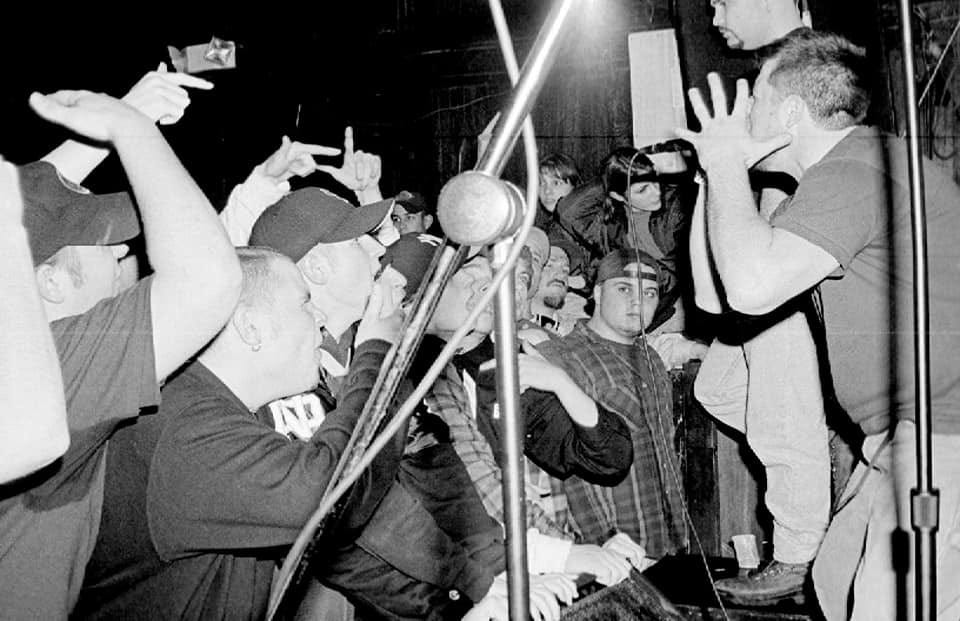
Ryan: I used to walk into the QE2 and literally the hair on the back of my neck and my arms would stand up. I don’t know if the electrical had a faulty ground in the place, or everybody was just fucking electric. I remember singing there multiple times, and I don’t know why it happened, but I would be singing and I’d be soaking wet, and they had that railing, I’d touch the railing and then people would reach up to grab the mic and touch my skin and somehow electricity was going through me, but I could feel like I almost got zapped. People would grab my arm and jerk away and look at me like, “What the fuck was that?” I think it was something faulty in the place. But there was something about that place. It felt like home.
How far out did Cutthroat play? Did you guys do any touring or were you mostly around the northeast?
Ryan: We played the South By Southwest Music Art and Film Festival once in Austin, Texas. But we would go to Buffalo and Rochester and CBs. We played a lot of places in Massachusetts. We didn’t really pound the pavement. Some of them guys got a van they bought for a couple hundred bucks and they just winged it. I didn’t want to wing it and break down. We liked playing Massachusetts, Connecticut, New York; we didn’t venture too far out.
RJ: I think at that time we were also kind of looking to get—I don’t want to speak for the entire band, but we were getting such a hype in Albany I thought we were going to get picked up by a bigger label at that point. Like Ryan said we literally had to do two shows back-to-back because we were turning away people. If you listen to stories of older bands like Motley Crüe or Metallica or any of those huge bands, they all started the same way. So, I thought we were going to get picked up by a label. We were still grinding and doing these one off shows here and there, but we were hoping to get bigger label support to get us on the road.
I want to backtrack and talk about writing the songs, especially the stuff on Swollen Shut and Hatebreedsrage. I’ve described it as Pantera-filtered-through-Sick-of-It-All. What was the mindset for that stuff?
RJ: It was always riff-oriented, of course. The early Cutthroat stuff from ‘93, right before we got Pearson, we were searching for our identity. We were influenced by everything. I was still listening to tons of death metal at that point, too. When we started doing Hatebreedsrage, I think I wanted to get a little away from the hardcore and get more groove metal. If you listen to Swollen Shut it’s definitely got that hardcore feel to it, for sure. I just remember consciously thinking, “I’d really like to get more Sepultura in this but without losing the hardcore vibe.” I was consciously thinking about those things and writing riffs, and then Ryan would come over and I’d show him.
Then when we got Pearson, the thing about him was that he had a metal background. If I’m doing triplets on the guitar like in “Hate Breeds Rage,” he could follow that with his kicks, just like Vinnie [Paul] would with Dimebag, So as soon as I saw that I was like, “Okay.” You can hear that, so when we get to “Food For the Snake,” for example, or we get to the later stuff, it’s becoming more metal because, honestly, that’s what I wanted it to be. Ryan’s voice was getting harder and more aggressive. I think writing those riffs really was a maturity. We were getting better at our instruments and Ryan was getting better with his voice. As far as lyrics, not to toot his ego, but he’s one of the best lyricists ever. I loved his lyrics, so I was writing riffs to match that attitude.
Ryan: I have a different perspective than RJ. RJ would have riffs and he would bring stuff, but when we really started writing our kick ass shit, it was like a jam session and then all of the sudden it would hit hard and it just felt right. It would start off as a jam and then then all of the sudden it would lock up. I always had a box radio with a tape so I didn’t lose it. You take a smoke break and then you go, “Oh shit, what was that? I know these are the notes but it doesn’t sound the same.”
I think a lot of the best stuff just came out of jams and then [synced] up and then we worked off of that. I would have objected to it if they were like, “Let’s write a song that sounds like this Pantera song.” A lot of our shit just came out of a jam room and it just locked and everybody could feel it. I was always on the tape so we didn’t lose stuff.
RJ: There was definitely a lot of impromptu riffs coming on the fly. I’d walk into the room and just rip a riff out of nowhere and I’d see Ryan’s eyes light up, and that’s when you knew you had something. He’d grab his notebook and the lyrics would start coming out. Ryan would help with arrangements, of course, he’d say, “I want to say this line here,” so we’d go an extra part. You can hear the evolution of Cutthroat, like I said. Go from ‘95, we did two things in ‘95, which is a lot for a band—Swollen Shut and the Hatebreedsrage record—but you can hear the evolution of the band just getting heavier and heavier. It was conscious for me. I knew for a fact that I wanted to be just heavier.
It was so fresh at that time. A lot of people nowadays when they think of metal bands, they think of that classic slow—what do they call it, caveman beats? I call it mosh parts, but those slam parts. That was really new back then. By the time we started writing slower stuff like that, you’re talking a couple years of that. It was really fresh.
Ryan: A band that I would say influenced us because I couldn’t get enough of it—was Crowbar. Man, those guys were a lot of fun. Those guys were fucking wild men when we played with them. I’ve never seen people drink so much alcohol in my life.
It’s interesting you bring up Crowbar because there’s a song on the East Coast Assault II comp, “Out of Desperation,” that has that slow, New Orleans sounding part in the middle.
RJ: It’s so funny you said that. Since I’m working on the reissue I went and listened to everything front-to-back and I listened to that tune, and I remembered it, actually. That part, in particular—Ryan is going to laugh his ass off because I never told him this—I really wanted Ryan to have a part. He liked that stuff so much. I do like Crowbar but I wasn’t a fan like Ryan was. I always liked Slayer, Possessed; the fast stuff. So when we did that tune I really wanted to slow it down because I knew he loved those kinds of parts.
One thing I always liked about Cutthroat, and it wasn’t anything I could articulate when I was younger but I get it now, is that you guys didn’t have traditional structures. Everything flowed naturally and you couldn’t just predict what was coming up next.
RJ: For sure. I think a lot of that, too, is that we were still learning. There was a little bit of stuff going on, too. In the ‘90s, musically—and this might sound like blasphemy to some people—doing guitar solos wasn’t really cool at that point. People were really getting away from that. Dimebag got away with it because he was a guitar god, and the bigger bands were doing it, but it wasn’t like it used to be. The focal points weren’t the shred parts; there was more ambiance. My point is that we weren’t writing traditional songs, doing bridge guitar solos; we were really just trying to write heavy parts and if you listen to the songs, it’s pretty heavy and then we try to outdo that part, and then we try to outdo that part. It’s just constant heaviness.
Ryan: The bottomline, we wanted people to go fucking wild on the dancefloor. We wanted people to leave that show going, “Holy fuck.” I used to go outside the QE2, dude would have his nose going over to the side and he’d be like, “Motherfucker, best fucking show I’ve ever been to.” I’d be like, “Dude, your fucking nose is fucked.” I wanted people to just have insane fun and just rage in there. I grew up doing that. You come out of that fucking room and you go outside into the fresh air and it felt like you were light. You got all your shit out. If you took one off the head or whatever, it was no big deal. It was just casualties of war.
Back then, you were connected with those people. I knew everybody in the fucking place by name, and that’s crazy considering how much I was smoking back then. We had this community; people looked out for each other. We didn’t need security at the place; we policed that shit ourselves. We welcomed you, but if you came in there and did some stupid shit, you would get your ass kicked in that scene. That whole QE2 scene was the definition of toxic masculinity. There wasn’t law in there, there was code.
RJ: Everybody really did look out for each other. I remember one time I was in the pit—Ryan was always scared of me going in the pit, like, “Do not hurt your fucking hands”—and I turned my head and got hit so hard in the side of the head. All of the sudden I feel someone grab me and pull me out and it’s Jason Bittner. Everybody, no matter who you were, was helping everybody.
Ryan: It was a good time. It didn’t always remain that way. It’s human nature. It’s competition; it brings out the ugly in people. You know, I put music away and raised my kids, coached hockey, you know what I mean? I put my music in the closet for like 15 years. I had to deal with people in different walks of life and couldn’t be that hardcore kid at QE2. I couldn’t act like that anymore. I’m being one hundred percent serious with this—the people with the mohawks and the shaved head and the fucking long hair and the tattoos and the piercings, those are some of the best, most honorable people with integrity. Those people stand out. I’ll tell you right now, the big “Oh, I’m successful”—a bunch of assholes. A bunch of shallow people with no soul.
I hadn’t been to a show, my buddy got me to come out again. I walked into the club and it felt good. I walk in the club and I feel heavy. I never would have got this perspective unless I lived that life after my music thing. It was heavy in there because of the people in there that go to shows—I’m not saying all people—but we were all damaged. We felt at home there. I think the people that are into this are different types of people. I think they vibrate on a different frequency.
I look at it as a spiritual thing now. When I was a kid I was oblivious to it and I was just doing it. It was where I felt at home, but I step back and I see it from a whole different angle. The music is just a beautiful thing. It just helped so many people, you know what I’m saying? I never made a goddamn dime on it, but you know what? I helped people. I influenced and helped people through that music and that’s a huge thing for me.
How has it been for you guys revisiting the Cutthroat songs with all this distance? What are your thoughts on the music now?
RJ: I’ve been taking a deep dive into it now. A little quick background, Chuck Pogan was the man who really got behind us with Hatebreedsrage, and he was the owner of Ruffneck Records which was based out of Clifton Park. He had a recording studio up there. He was really the first one to get behind us, to help us get our music out there. I started Wax Assault Records, as we discussed, to do some classic thrash records, and a friend of mine said, “Why don’t you do the Cutthroat stuff?” I was like, “Nah, the past is the past.” But me and Ryan have always talked over the years.
Going back and revisiting that stuff I’ve grown to appreciate it now more than I ever have. I critique the hell out of Cutthroat because I was so young, and as you get older you get better at your instrument, you become more mature in your songwriting. You listen to Within the Fire, Within the Fire sounds absolutely nothing like Cutthroat, obviously. Having said that, I always over-critique everything, but now listening to it—Ryan’s voice on some of this stuff. I even said to him a couple weeks ago, “Dude, what were you pissed about?” I’ve never heard so much fucking real anger, and it’s awesome. Its’ been a real joy for me, and Ryan’s been hounding me for it, but I’ve been waiting to get the actual master before I send it. I want him to hear it remastered.
It’s been fucking awesome and I really think if me and Ryan decide to do some music—wink, wink—I think it’s going to be bigger and fucking better than anything we’ve ever done, and I think it’s going to be really a good closing chapter of the legacy of Cutthroat. At the end of the day the way I always looked at Cutthroat—and you nailed it, Colin, all the local bands were really different and they had their own sounds, I think Cutthroat had their own, too. I’m really excited for this last chapter of the band. I never thought it would happen. It was thirty years of silence, but it’s happening.
Ryan: When [RJ] decided to call me and pitch this to me, it was the night of the Straight Jacket [thirty-year anniversary] show. Mike [Valente] from Brick By Brick, he sent me a message that said, “Are you coming to the Straight Jacket show, and if you are, will you sing ‘Hate Breeds Rage’ with us?” I said, “Yes and yes.” I ain’t been on a stage in like twenty-five years, I ain’t sang with a microphone, I didn’t go practice this song with them; I didn’t do nothing. So when I’m doing the song he’s calling me to talk about doing the Cutthroat thing.
What are the odds of that happening? The next day he calls me like, “Dude, that song you did is all over Facebook.” A lot of things going on in my life—I’m older, my kids have grown up, I just kind of feel like something is giving me a calling or something. You’re getting up there in age, let’s let this thing rip. It’s going to suck for me because I’m going to have to cut down on cigarettes. I’m going to have to hit the goddamn treadmill.
It is exciting and I feel blessed. And I’m humbled that people remember anything from thirty years ago.
OFFICIAL UNOFFICIAL ENDORSEMENTS
In the ‘endorsements’ section of No Limit on the Words, the interviewees take a moment to officially unofficially endorse anything that they think is worth checking out.
Ryan: Fender Studio One Pro
I endorse Fender buying Studio One and I just got a Studio One Pro update for my studio and it’s nasty. Fender Studio One Pro, because it’s the gift that keeps giving. I just walk in and here and use it and it’s the best. It’s like crack cocaine but it don’t ruin your life. I can’t really say that because maybe it did ruin my life.
I also just want to give a shoutout to anyone who has a family member suffering from Alzheimer’s.
RJ: Discogs / Skeletal Remains
I’m a huge vinyl collector so I’ll give an unofficial endorsement to Discogs. I’m really happy with their new app and I love what they’ve done. For a huge collector like me, it makes cataloging my collection easier and fun. I’m able to share my list with people, like, “Hey, you want to check out my collection?”
For new music, I was trying not to be the old man that only likes stuff from the ‘80s and ‘90s, but Skeletal Remains for a newer band. They are very killer. Loving their stuff. I hope they’re still a new band—I could be wrong—but they’re a newer band to me and I’ve definitely been digging them.
That’s all for this edition. Thanks for reading. And thanks to Ryan and RJ for letting me ask them questions about things that happened thirty years ago. If you liked this, share it with a friend.
Fantastic oral history. The Crowbar/Pantera comparisons capture somethig real about how regional scenes built identities before everything got flattened by algorithms. I ran soundboards in the midwest during similar years and that physical electricity Ryan describes was legit, old wiring and humidity combined with massive crowd energy.