
047: Take Steps
The Albany hardcore band discuss the finer details of writing their eclectic debut full-length, 'Fighting Chance.'

“The reason we needed to do a full-length this time around is because of the diversity of the songs. The concept would not have gotten through with just an EP.”
-Charlie McClosky
The songs on Take Steps’ debut full-length, Fighting Chance, are as likely to stir up some two-stepping and sing-alongs as they are stage dives and windmills. One minute the five-piece are laying out a catchy pop hook, the next laying down a beatdown breakdown, all-the-while cruising through some melodic hardcore and pop punk in between.
Just last year the Albany, NY based band released their self-titled four-song EP, which was mostly written by guitarist John Lombardi, but on Fighting Chance, the rest of the band—filled out by guitarist Charlie McClosky, vocalist Kyle Miller, bassist Craig Mahar, and drummer Dylan Galea—have brought their own unique contributions as well. The collaborative result is an eclectic amalgamation of styles and approaches, one that can be traced across the album’s dynamic ups and downs.
“Everything is on the table,” says Lombardi. “As long as we’re all together, this is cool and it makes sense.”
It’s all been laid out on Fighting Chance. The record is simultaneously heavier and poppier than their EP, and the statement it makes is as intentional as the finer details the band puts into each of their tracks. Meticulously crafted and deliberately executed, the record feels like it was made by a band hitting their stride well into their career even though Take Steps have barely been around for two years.
With the band putting the finishing touches on the mix, all five members took the time to talk about how it all came together, the process of collaboration, and to, of course, give their Official Unofficial Endorsements.
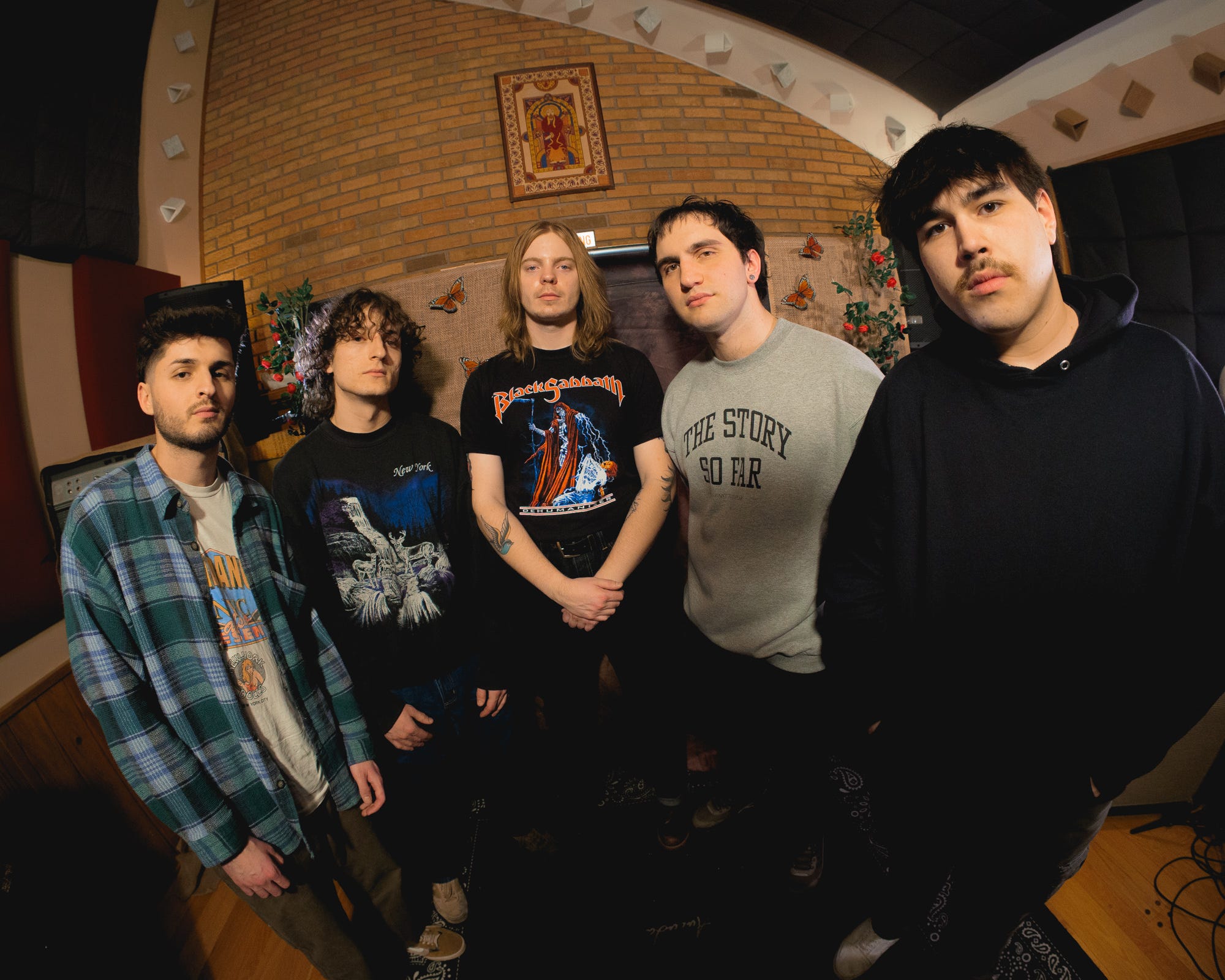
To get things started and to establish everything leading up to this record, can you give me the brief history of Take Steps?
John: Spring of 2024 I got out of a band I was in and I was figuring out what was next. It was a pretty big part of my life for a couple years. I was just chilling for a bit and not spending too much time on music for a couple months, and then I started listening to a ton of [Comeback Kid’s] Wake the Dead and [Have Heart’s] The Things We Carry. I had gotten into hardcore but most of what I had gotten into was more of the metallic modern beatdown stuff. The first thing that I remember really being like, “Oh, this is hardcore music and this is really cool,” was when [Knocked Loose’s] Laugh Tracks came out in like 2017. So I had a handful of bands that I listened too, a decent amount of crossover bands—Power Trip, I’ve been a fan of forever.
So around that time I was just going through a lot leaving that band and I was just getting really attached to the lyrics in a way that I hadn’t before. I had never really listened to any straight edge bands like Have Heart before, so it was resonating with me heavily at the time, so I just sat at my computer and started putting stuff down. I put together what ultimately would become “Back and Forth” and “Wide Awake” as a demo in Ableton. Charlie knew about all of this as it was happening because Charlie and I had linked up a year before because I helped co-produce a record that Charlie made for Bad Impressions.
And I had seen Kyle play a show with Social Propaganda, which is one of his other projects, and I had been seeing them play for years at this point. I saw a show with them and Kyle was ad-libbing some intense vocals almost scream-like, and the energy there and the stage command was something I clocked into my brain. One day I invited Kyle over and was like, “Do you want to try and put lyrics down?” We worked a lot going back and forth and it was kind of cool. From there I asked Charlie if he wanted to get involved as a drummer and then we started talking about actually playing the music together with a group of people.
Kyle had suggested that I ask Craig to play bass. I just didn’t know that Craig was about this type of music. We had this conversation, but I had no idea that Kyle and Craig were into pop punk at all, and we went to high school together, and I didn’t know they were into skateboarding. It was funny to, in retrospect, realize we had similar musical DNA, we just never spoke about it.
There were a couple people who were involved in the beginning as we were settling things. Charlie ended up playing guitar after all, and we wrote “Take Steps” and the intro [”One Final Effort”].
Kyle: We wrote the single that we just put out, too.
John: Oh yeah. “Everybody That Loves You” has existed since July of 2024. There was a decision made when the EP came out that it was just not really the right fit for it in context with the rest of the material. I was also adamant that I needed to sit on it more. I knew that when I wrote it with Kyle that it was going to be a lot more involved arrangement and production-wise and I needed to think about it.
Fall of 2024, we went into the studio with Tyler [Kruspky, Pacemaker Audio] for the first time. 2025, we played our first couple shows with Sean [Barney], who plays in Sunbloc. He was kind enough to play drums with us on a couple shows, and then eventually Dylan came in as our full-time drummer.
So for you, Kyle, as the first one to enter with John, what were your immediate thoughts on what he was working on?
Kyle: I was super taken back and, honestly, just grateful that he asked me. I was blushing, lowkey. I knew John was a really good musician, and I knew that he was in really dope bands and was in the scene. I had just started playing guitar around that time and started a band called The Last Miller. John just asked me and I had never really done something like that and never really thought that I could be a vocalist of a heavier band. John has helped me every single step of the way; Charlie has helped me every single step of the way; Craig has helped me every single step of the way; Dylan has helped me every single step of the way. They are so good at what they do that I had to do whatever I could. Craig and I have actually been friends since fourth grade, and not a lot of people in our friend group played music, but we had gotten into hip hop and started really diving into trying to make beats and trying to rap and do all that stuff and we kind of fell in love with it. That led into us making more music and us wanting to branch out and develop more.
Were there conversations early on about where you guys wanted to land sound-wise?
Kyle: There was a lot of talk about that. It’s hard to say because it was all so up in the air. We could be a singy band; we could be a pop punk band; we could be a hardcore band. I think John and Charlie and I had a lot of talks about that in the beginning.
Charlie: Me and John were very well acquainted already when he was working on putting the band together. I was doing Bad Impressions at the time, and I was doing Cinnamon, and still at SUNY Schenectady, but I knew John was thinking of doing something with Kyle, and I was excited to see if something came of it.
Fast-forward to May of 2024, John sent a Google Drive link to what was basically a demo of “Wide Awake,” which, speaking about what John was influenced by at the time—Comeback Kid, Have Heart, the uplifting melodic bands—I could totally hear the influence super strong. I think you still can; you can tell where that song comes from. I was stoked on it.
I was definitely feeling spread way too thin at the time, so I wasn’t confident that I could commit to it. I knew John was looking for a drummer, and I was wishy-washy at first, but I knew it was too good to pass up. We all like very different stuff, but we also like a lot of the same stuff, but I think it took some time to really get comfortable with what we wanted to do. I think all that took was just writing more material together. This record is a great example of that.
Kyle: The EP was written more by John. Charlie hopped in with drum ideas, helped with arranging the tracks and helping me figure out vocal parts. John helped me figure out vocal parts. But the album that we’re releasing reflects everybody.
Charlie: I think it just took more material shaping up to establish what we want to do. I’ve been adamant on not wanting to put a label on what we’re trying to go for. We love a bunch of pop punk stuff, we love a bunch of hardcore stuff from different areas of hardcore. I spend a lot of time doing things with more strictly hardcore bands, but we have so many different influences that I think all it took was collecting more material to figure out for ourselves what we wanted to do rather than putting a label on it before the material is there.
Craig and Dylan, I’d love to hear from you guys about the development you’ve seen in the band since the time that each of you got involved.
Dylan: I was the last member to join the band and it was funny because I was playing a basement DIY with my other band, Torpedo Lane, and John had showed up and kind of planted the idea of me joining the band. Similar to Charlie, super busy schedule balancing life and two bands, but I just couldn’t let it slip. The first EP had already come out and I already knew who Take Steps was and I was a fan of Take Steps. I remember when the EP dropped on Bandcamp I was at SUNY Schenectady recording with Torpedo Lane and I was just blown away with the Take Steps one. Months later, John comes and recruits me like a drill sergeant. It’s awesome being able to jump in.
Craig: I remember specifically being in the car with Kyle on the way to a Last Miller show in 2024 and he showed me the demo for what came to be “Everybody That Loves You” and a few more demos. I remember saying to Kyle, “I really want to play in a band like this,” and Kyle was like, “Just text John.” I thought he probably already had somebody lined up, he’s got a lot of really great musician friends. Like a week later John texted me asking if I wanted to be in the band. It’s been super sick ever since then.
The biggest difference between the EP and this album is collaboration. The EP was all pretty much demoed out initially and we were given the songs and told practice it and get ready. I think for the album, half of the songs were demoed completely before we brought them together, but at least five of them we made together. Charlie would bring an idea to the table, we would build off each other, and then it would build to something else. It’s proven to be really fun and really interesting. I think we all bring unique perspectives to the table and we all have different influences.
Charlie: Yeah, and going back to it being more collaborative—”Everybody That Loves You” has been around since the beginning; a song like “No Resolution” was also a little early; we had demoed it. It was a while before we really started trying to lock in on making a full-length. John pitched this idea, and it’s a really obvious idea, but we wanted to not over-work the songs before we give the demos to the other members. We wanted to give it a chance to live at the practice space and just work it out as a full band, and I think you can really hear that on songs on the album.
“On Your Own,” “Company,” and “Fighting Chance,” those are three songs that I really think about that time and it was really just us five locking in at practice and trying to write sick music, and I think it really worked out that way. If I were to note one big difference from this time versus last time, it would be that.
Continuing off that concept of being more collaborative, what is the evolution of a song for you guys? Every song on Fighting Chance has a different vibe; they don’t all follow the same structure or feel like something is being forced in just to have it there.
Charlie: For example, “Company” was probably the most collaborative song that we ended up doing. Like, I’ll come up with an idea and I don’t necessarily have an idea for what it’s for or sometimes I have a broader picture of what I want to do—maybe I really do have a direction I want a song to take—but “Company,” that main riff was actually going to be a bridge to a totally different song. I ended up using other parts of that song somewhere else, so I just had that leftover and I thought, “How sick would it be if it started a song and then the snares come in?” And it’s this more atmospheric, emotional song rather than what it was going to be. We really worked that all out together. I can attribute the actual arranging of the song to John. John had ideas that were things I wouldn’t have even thought of. It’s different every time, how a song comes about, but it’s usually small ideas that eventually get pieced together into something bigger.
John: As far as putting the songs together, a couple of those were kind of those, like Charlie said, had riffs or were mostly arranged. It was either “Company” or “On Your Own,” or both, where Charlie sent a demo with demo drums and guitar and I just put a part on it. Then it was like, “Okay, this is the vision for my part, we might want to move a couple things.”
Aside from that, the songs that I did the lion’s share of the work, my songwriting process is very much influenced by pop music mostly. I’m very much, I guess you could say, a traditionalist in that sense. My previous band that I was in, a lot of the practices of songwriting were very conservative in ways that not necessarily are negative, but the kind of thing where I really feel the value of the song can be lessened if things overstay their welcome. Kyle knows this, and when we’re working together it’s pretty much a process of getting rid of shit more times than not. There’s a lot of putting something in initially and sleeping on it and then being like, “No, can we shorten this and make it more concise?”
To get into particulars, I’m very much of a Max Martin school kind of guy. I know this has no swag and we’re talking about hardcore music, but “Teenage Dream” [by Katy Perry], there is basically five choruses on top of each other and three of them you don’t even notice are there. That’s why that song is huge. I have the tendency to write choruses, Kyle and I put a chorus together, we try to find a place where it can peak, balance that out with singability in a practical live setting.
Also on “Company” and “Everybody That Loves You” for example, there are sung lines that are essentially secret choruses. Like, at the end of “Everybody That Loves You,” I sing a part under the main melody to kind of elevate the third chorus to have more energy. The same thing happens in “Company,” but it’s a little bit quieter.
I draw from the big schmutzy expensive pop music songwriting tradition, I guess, which is not cool, but I listen to that music a lot actually. It’s just kind of left over from making pop and pop rock, but there are certainly times where that’s not what it calls for or you gotta just let the song go. Perfect example is, the last song is six minutes long. There’s a whole fucking end where it just goes. Sometimes you just gotta let it be. The record’s thirty minutes long, I’m not concerned that song is six minutes long. But there are times when it’s important that you’re conservative with your songwriting, it’s important that you’re trying to be concise and you don’t linger too long.
As far as structure, that’s kind of where I’m coming from. And there are influences outside of that. In the heavier songs it’s drawing more from getting the stuff out of the way, and then the riff at the end. Like “Money in the Bank,” that’s like Dave Mustaine on “Peace Sells,” and the whole front half of it is like whatever and the whole point is to get to the end. A lot of Mindforce songs are like that; even Hatebreed songs are like that. Like, “This is the vehicle to get to mosh part one and two.”
You’ve gotta also think about the live setting. As far as the hardcore part of our music, making sure that it works live. Charlie is also super important in this happening because they just have way more experience playing more hardcore shows than I do. We visual what’s going to happen here. I have a tendency to write stage dive parts, but being like, ‘Practically speaking, how can this elevate a live set as a mosh part, dance part, two step?” There’s so many fucking two step parts in our music and it’s not intentional.
That whole pop aspect you were just mentioning, I was actually going to ask how intentional it is. How conscious are you of the writing of these hooks?
John: One hundred percent. Kyle will come in with a chorus or I will have a chorus and then we lay it out and then just start taking stuff out. It’s like, “How can we make this direct, lyrically speaking? How can the pentameter be not redundant as far as syllables go?” Like I touched on earlier, it’s gotta have an arc. On top of all that, and this is sometimes the hardest part, is making the sacrifice of, “Can I sing this live?” For me, and I think to Kyle, it’s important that this music can be replicated live. The whole running the X32 with five stems going of harmonies is not something any of us are interested in.
Kyle: To go back to the songwriting thing, basically John and Charlie will send a demo and I’ll be washing dishes or doing laundry or something and I’ll be listening to it. I’ll just think of something and I end up writing a demo and send it back to them, and then, like John said, we do a little surgical operation on it and take away a lot of things. John is really good about arranging a song and knowing when and what a part should have. Charlie is really good at that in the same sense.
I think a lot of the time I write about whatever is going on in my life and my aggressions and the people that have wronged me, and I’m trying to get out of that and write about more positive and happy stuff. I think on this one John really helped me the whole way and he kind of held my hand through it all. He helps me become a better artist every single day.
Another key aspect to Take Steps is the way the guitars interplay with each other. There are interesting contrasting lines that are happening throughout that add to the overall melodicism of a lot of parts. What’s the approach for you guys on writing these interlocking lines?
Charlie: I think the most important element of writing songs is to be building contrast rather than complexity. Me and John, I think, do a pretty good job at doing this, where if you solo’d one of our parts at a given moment, we’re harping on one chord or one small thing repeating. But meanwhile there’s something going on underneath it that’s building complexity because you have these two things that interact with each other and create something bigger. Most of my best ideas happen away from the guitar. I’ll be at work and I’ll be bored and thinking about music.
I’m a guitar player but I try not to just write songs for the guitar. I am thinking about how the whole song interacts with each other. I’m thinking about how much space the drums are taking up, how much space the bass is taking up. There’s five people in this band, it’s going to fill up fast, and we’re not a grindcore band. We’re not trying to do that. For example, a song like “Fighting Chance” is where I really started to grasp that concept. I actually got in a songwriting rut probably at the tail end of 2024 where I realized I was just writing these songs and they were so bloated because I wasn’t thinking about the drums and the bass and how much room there was for vocals. I was just writing this stream of riffs, and this less-is-more philosophy is easy to say but it’s really vague. But I think the concept of build contrast, not complexity is the way to go. When you build contrast you get complexity.
Sometimes you’re in a band with guitar and that’s all the band needs, and that’s great, but a band like Take Steps really thrives with having these interactive guitar parts that contrast with each other.
John: This is another something I took from playing in a pop band, which was a culture shock when I started doing that stuff—learning how to only play what you really need to. I am actually a bass player first, so I have no problem just chilling. I was doing an interview the other day and we listen to a lot of the same bands like Blink and all that, and I was like, “Yeah, I just play the longs most of time.” If you play guitar, that’s the power chord without the fifth. It literally has no tonality because there’s no defining—it’s not augmented, major, there’s no third. But what it does do is create an anchor point the rest of the song moves around.
That’s part of the reason Blink 182, as a three-piece, was able to get so much mileage emotionally out of their songs, aside from the part where Jerry Finn is doing incredible things arranging the harmonies and the vocal parts. There are so many bridges on those records where Tom is hanging on to one or two chords and then Mark moves. The bass moves. Sometimes it’s shifting into multiple progressions at once. I think it’s an excellent way to reflect a lot of emotion sonically, at least that’s how I feel when I listen to it.
We can’t afford for us all to be playing different parts and then have a keyboard player lay down the pad. There’s tons of bands, even heavy bands, where the song doesn’t work without that. If you were to hear them play without tracks it wouldn’t work. The two guitar thing was also super influenced in general by the bands we like. A super heavy influence on the way that I interact with Charlie’s parts is Corey [Galusha] and Nick [Cogan] in Drug Church and the way that they have their guitar parts set up. Nick is doing so much, but he is doing his best to really intentionally put parts in that are elevating the song and interacting with Corey’s parts. Or Blink, again, they only have one guitar player but it’s sort of the same feel.
It’s all about trying to elevate the song. I have no problem doing the simple things so that the rest of the arrangement can shine. My favorite band is Metallica. Every time I’ve tried to write a guitar solo for this band I always take it out, except for one time on the EP. I guess that’s not true. “Fighting Chance” was the one time I went opposite and I was like, “Charlie, you need to shred.” Charlie will be modest, but Charlie is an exceptionally good lead guitar player, significantly better than me.
Sorry, I have a tendency to ramble, but yeah, trying to be intentional and be conservative arrangement-wise with guitar in a way that is positive. At the end of the day we can get in our heads about parts, and there’s a singer and he’s got words that he has to sing. So you gotta get the fuck out of the way. In my eyes, Kyle should always be the star of the show. It’s hardcore music, it’s pop punk, whatever, but the lyrics, that’s what people connect with. Riffs are sick and there’s a time and place, but I’d much rather chill on my parts and just let Kyle deliver something that can really connect with anyone because that’s the beauty of the vocal.
This is guitar-driven music so, of course, the guitar players get all the love, but Craig and Dylan, what’s your approach to finding your space in the mix?
Dylan: I would say for me, similar to how we really let the songs develop at practice, I feel like everybody in the band is smart enough to help me with drums. A really good song that we developed riff first is “Company,” and I do what I can for the song without going too crazy. Sometimes I go a little too crazy. I remember in the studio with my double bass, John was like, “Easy with the flutters.” Just not going overboard and letting the song breathe and being worth more instead of doing crazy stuff over it. Just letting the riffs come at me and doing what I can in the song in a simple but dominant way.
Craig: It’s definitely been a learning experience being in this band. It’s awesome working with John, who is a traditionally trained bassist. I think a lot of the times I initially thought that I maybe wasn’t doing enough and then come to find out it was just enough. I think a lot of times less is more, going back to what John was saying, especially being a bassist. You can do too much and it can really get in the way. What’s cool about this record is that it just depends on the song. Certain songs really push me as a bassist and John wrote some really gnarly parts that have made me practice a lot and made me a better bassist. I think there’s a time and place for each approach, but I just try to fit in where I can, essentially. That’s what’s really been helpful about working these songs out together, we can literally all figure it out together. If someone has an idea to do something a little differently, we can figure it out in the moment. Definitely just figuring out where to fit in tastefully, when to crank it up a bit, when to dial back.
The diversity of it all is really interesting. The album has all these dynamic ups and downs, and it has heavy breakdowns and catchy pop hooks, and that plays into the types of shows you guys are on, too. I saw you with Flatwounds at the Hangar and you did a cover song I didn’t know, but the audience went nuts to it.
Kyle: Fall Out Boy. It was insane.
Yeah, and then I saw you open for Carnwennan at the Madison Theater and it was all doom and sludge bands except Take Steps. And then the show at Empire Underground where you did a Slayer cover. The night before this interview you played with Angel Du$t and Combust. It feels like you can sort of fit in anywhere.
Charlie: The reason we needed to do a full-length this time around is because of the diversity of the songs. The concept would not have gotten through with just an EP or just releasing singles because what keeps the thirty-something-minute album interesting is that the songs keep going back and forth with different dynamics. It’s a very dynamic listen and I know personally that’s just what I love in music. I don’t want to make a thirty-minute album that is super monotone the whole way through. That can be accomplished with a ten-minute 7-inch.
What ends up happening with this, which is something I think is really great about this band, is we end up being able to curate these different setlists depending on what seems right for that particular show. Last night we played with a band like Combust and Angel Du$t—super sick hardcore bands—and we can dial it up a bit. We can play songs like “Money in the Bank” and the more intense songs in our setlist, but maybe a different gig, like when we got asked to play with Piebald back in December, that’s more of an emo bill. We played songs like “Company.” I really like playing to that strength; we have these sides of our sound and we all like dynamic music and want to come across that way.
John: Like Charlie said, it had to be an LP, and another reason it had to be an LP is, it’s diverse, but what that means is that as an artistic thesis statement of a band, no one can ever tell us that it wasn’t okay that it was like this. Here’s our first record, it’s heavier than the first one, and there’s an acoustic song on it. Everything is on the table, as long as we’re all together, this is cool and it makes sense. I thought it was really important that we established early on that we’re a band that’s not going to be just doing one thing. It’s important.
Hardcore is sick and it’s cool that it’s so steeped in tradition, and there’s lots of bands that do something and do it really well. I’m not knocking that at all, but our stylistic influences are diverse enough that I wanted to put the right foot forward. I guess I don’t know how people are going to receive it, but I think with smart track-listing—and we went over the track-listing for this a lot because we wanted to make it work. It was figuring out how the puzzle worked and I think we got it.
To pull out for a little bit, the record starts high energy and then it ebbs and flows a little bit between some more posi stuff into heavier stuff to ramp it up, and then let it come down a bit. The apex is “Fighting Chance”—the second half is just ripping off “Master of Puppets.” The comedown from that is, here’s this really sweet-on-the-ears acoustic song so you can decompress and then it ends with the longest song that is very overtly heart-on-sleeve reflective on a lot of the lyrical themes that Kyle and I pushed for in the band. It’s an extremely emotional song for me, personally, and it just felt right.
There’s more material written and it’s all kinds of different stuff. I know Charlie has stuff that’s written that’s way different than the stuff that I have written. We’re not going to let anyone tell us what we can and can’t write. We know what this band is about and it’ll be what we think is cool. Sometimes I get scared about what people are going to think, and Charlie is like, “If you’re true about what you really love it’s going to work.”
Kyle: This whole album is a testament to how diverse our music taste is. We all know what we like and we all know what we want to hear. Every single song reflects that, especially the ninth song, “Shallow,” that John and I wrote early on. Around when we wrote “Everybody That Loves You” we wrote that, and John just picked up his acoustic that was in this crazy tuning and he just started playing and it just formed off the bat. It was a really special moment because that solidified that we can do whatever the hell we want, and this band can go in any different route. It doesn’t have to be just hardcore; it doesn’t have to be just pop punk. That was one of the questions early on, but we realized we can just be whatever we want.
What can you tell me about recording with Tyler at Pacemaker? How has that played into the overall sound of Take Steps?
John: Overall, [Pacemaker] is a cool spot to work because it’s pretty chill. With the EP I kind of knew what I wanted it to sound like. Charlie and I both have Associate’s degrees from Schenectady for audio, Kyle went for a beat certificate. Everybody in the band has a general understanding of recording and mixing to some extent. I knew going into the EP this is going to be Marshalls and SVT and pingy snare. Going into the album we had more time to try different things. Drums, there was a little more time to be dedicated to figuring out drum sounds; Craig used a bunch of different basses and some DI.
There’s ten songs so we had to give ourselves a lot more time this time. We were definitely trying to be more intentional with things and if something wasn’t right then we’re going to fix it. [Tyler]’s got a lot of emotional investment in this too. He really cares about this band, and he’s left a mark on our band and we wanted to make sure it was as great as it can be. Everybody put so much effort into it, so much time, so many late nights.
Having somebody who believes in you like that when you are really frustrated when you’ve been going seven hours. I’ve recorded DIY stuff, but I’ve also recorded at larger studios. It makes a difference when someone genuinely cares and they’re not just there out of obligation. In that way I feel like Tyler has been indispensable in providing a positive morale when sometimes it’s just not there.
Kyle: He makes it feel like home when you’re over there. He makes you feel like you’re his best friend even if he just met you. He really is just a guy who puts his hand out for strangers and he puts his best foot forward with every single project that comes into that studio and he works hard every single day to keep that place going. Shoutout to Olivia. Credit to Olivia for putting up with him and putting up with us. Shoutout Rufus and Fiona [the studio dogs].
For each of you, what’s your favorite song on Fighting Chance and why?
Craig: “On Your Own” is my favorite because: (one) we made that one together, I’m pretty sure that was a collaborative effort, (two) it shows both sides of us in one song. It does have a very catchy chorus and it has a pop punk feeling to it, but it’s also pretty heavy. It’s my favorite ending of a song on the album. It has a super climactic ending. The whole song is building up and the end is a huge breakdown. It’s a good representation of what we are as a band.
Charlie: The cliche answer is to be like, “I like all of them,” and I do feel that way. I think for the album experience it’s probably “Heroes” because it’s building up to this point. The way that the emotions and energy ebb and flow on the record, and then “Heroes” starts, it’s like this reset and it sounds like this clear blue sky. It’s a really emotional song and once I hear that intro riff I’m like, “Oh shit, here we go. This is the big finish.” It’s probably that, but I am a little partial to “No Resolution.” I think we hit a really cool early 2000s hardcore vibe with the verses and the mosh part and the breakdown, meanwhile the chorus is still a strong melody, and we have a feature from Ben [McColgan] from NOIR and Federal Charge.
Dylan: I’d say for me, personally, having listened to so many different mixes of the songs so many times, it’s “Heroes.” Similar to what Charlie said, big ending, longer song, emotional. Anytime I hear that song I immediately relate to all the work we put in. I hear that song and I just think, “Damn, we busted our ass to do this.” I have a special connection to that song, but a close second is “Money in the Bank.” Straight to the point, just hard as hell.
Kyle: Mine is probably “Shallow.” It was definitely the most cathartic for me to record and it was the one I was most excited on going in to record. I was so ready to knock that one out. Second favorite is “Money in the Bank”—shoutout The Joe Snot Bombs Skateboarding. Riverside Park, represent. He got his feature on that song. John and Charlie going back and forth in the beginning; it’s just so good.
John: When I wrote “Heroes” I was thinking a lot about my parents, when I wrote the music. Every time I listen to it, it fucks me up really bad. The song means so much to me on a personal level. Favorite? Maybe. My favorite lyric on the album is at the end of “On Your Own.” “After all this time I still kept a hold of what matters most.” That’s so sick. You know what? I’m going to say “Bad Start,” the opener. That shit fucking rules.
Kyle: That shit’s for the divers.
John: I wrote that song for people to stage dive to and do nothing else, and they better fucking do it at our release show or I’m going to be really upset. It’s just fun, short; it’s catchy.
OFFICIAL UNOFFICIAL ENDORSEMENTS
In the ‘endorsements’ section of No Limit on the Words, the interviewees take a moment to officially unofficially endorse anything that they think is worth checking out.
Kyle - Fortnite
I love Fortnite. I’ll be the first to say it; I want Fortnite skins for all the Take Steps lads.
Dylan - Wild Hogs
I have to endorse the movie Wild Hogs because we had a joke like, “People are going to crank their hogs to this shit.” It’s a motorcycle movie. Either Ghost Rider or Wild Hogs. Especially in “Money in the Bank.” I remember we played it in New Jersey and I looked down and they were doing the motorcycle starter thing. Me and John were just in awe in that.
Craig - Silence
Try out silence, kids. Shut your phone off, go for a walk, spend some time in nature, meditate fifteen to twenty minutes. I think you should give it a shot. I think it can help out your life in a lot of ways, and it’s underrated—sitting in silence without any distraction.
Charlie - Twisted Metal
When you’re so focused on one specific medium for your passion, like most of my passion related stuff has to do with music, and that’s expanding a little more as I grow up because I cook all the time now. But for some reason I always find myself going back to these video games from my childhood which includes Twisted Metal. In these weird ways I pull inspiration from it. There’s nothing more refreshing to me than when you pull inspiration from something that’s outside of the medium that you really make your art.
John: Mr. Wok in Burnt Hills, NY; weird settings in the Halo games; 2006 Honda CRV; Charlie
First off, in Burnt Hills there’s a small strip mall. In this strip mall there is a dollar store, a book store, a CBD store, a Subway, and a laundromat, and a liquor store. But there’s one more business in that strip mall and it’s called Mr Wok. It is a Chinese takeout restaurant—nothing exceptional, nothing out of the ordinary, it’s just really fucking good. If they were a publicly traded company I would own them.
Second thing is if you play any Halo game past Halo 3 and you go into the settings there’s a way where you can turn the gravity all the way off and ramp the speed up all the way. You jump up really high but also move really fast on the ground and you just start flying around in the sky shooting rocket launchers at each other. Everyone, if they have the game, should try that at least once.
I want to shoutout the 2006 Honda CRV. Great car. That whole era of 2004-2007, just great. There’s so much space in the back; great mileage; reliable.
I also want to shoutout Charlie.
Kyle: Also, shout out Eli for co-producing the album and recording and being helpful through this whole process.
That’s all for this edition of No Limit on the Words. Thanks to all of Take Steps for taking the time to speak with me. If you liked this, share it with a friend.