
051: INTERVIEW - Sunbloc
Matt Bradley and Keefer Richard talk about combining the band's rock and hardcore tendencies to make their new 7-inch EP, 'Joyride.'

“I feel like our music is a very outwardly energetic, exciting, happy piece outside, but inside, a torn-up person getting their thoughts out.”
-Matt Bradley
“Sunbloc’s Sunshiny Aggression” was the title of an article I wrote about the Albany-based rock/hardcore band, Sunbloc, in 2024. It came from a direct quote from vocalist Matt Bradley and bassist Keefer Richard describing the band’s music when I originally interviewed them for the piece. That article was never published.
But here we are, two years later, and the sentiment remains true—maybe even more so. In the time between, Sunbloc released a scathing hardcore EP, Enemies at All Times, which expanded on the more aggressive side of the equation, before pulling it all together for the eccentric tracks on their new 7-inch, Joyride.
Joyride seamlessly fuses the noisy, ‘90s-inspired alt-rock style they developed on their debut EP, Sunday Music, with the blistering hardcore of Enemies at All Times. It’s evident straight from the get-go, and it makes perfect sense. The band weaves together catchy refrains and fuzzed-out guitar leads with hammering rhythms and a penchant for surprise.
With the record recently released (vinyl via Immigrant Sun, cassettes via New Enterprise), Matt and Keefer took the time to talk about how it all came together, and to, of course, give their official unofficial endorsements.
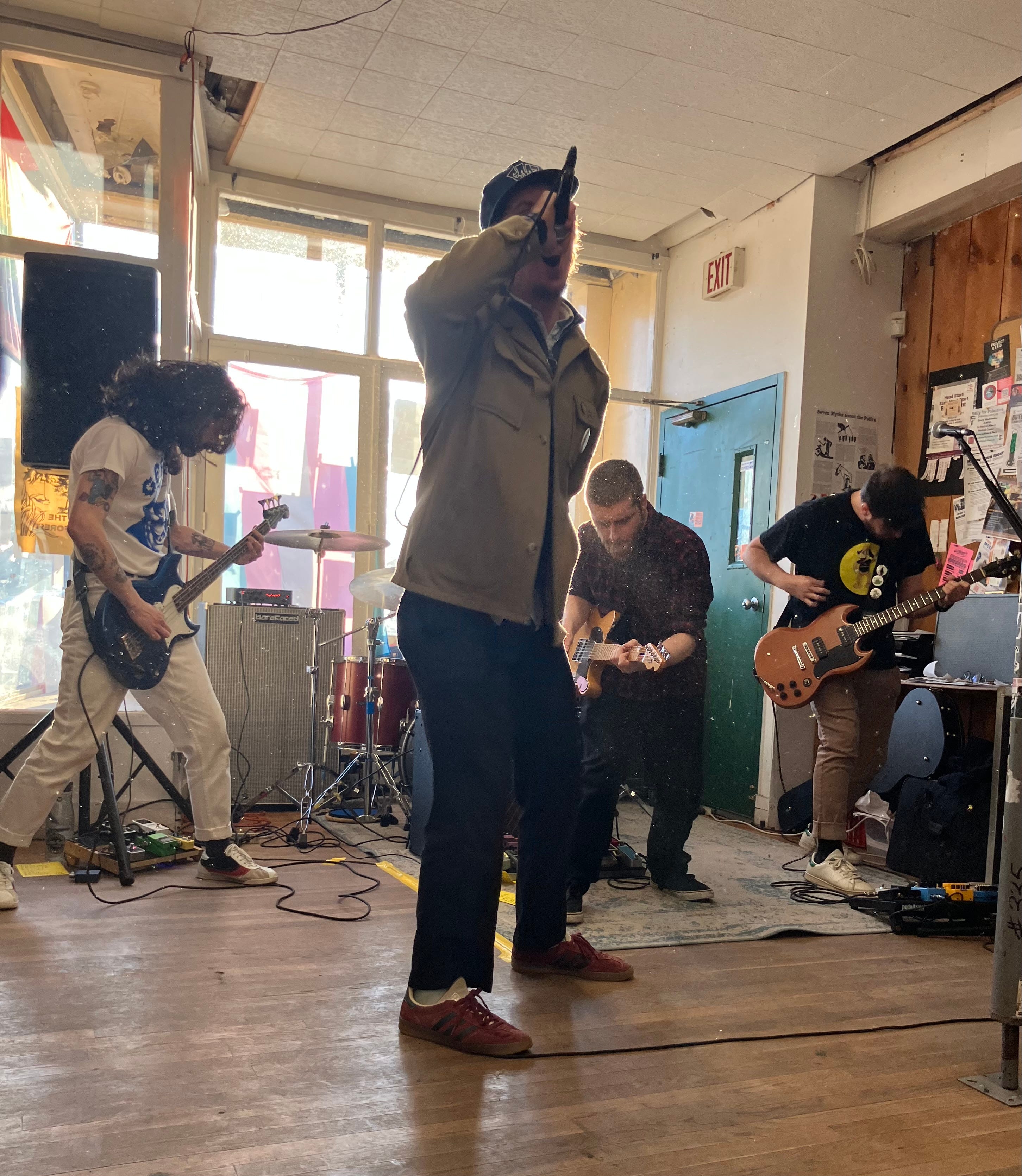
Can you guys talk about how you started and the whole progression of the band into this batch of songs?
Keefer: There was an idea for Sunbloc in like 2018 that started with me and Sean [Barney], the drummer, and a different singer and a different guitar player. We did that for several months but it never really left the practice space. Then the pandemic happened, so that all kind of fizzled out. More time went on and me and Sean were talking about doing it again, and me and Matt had been in bands previously. We needed a singer, and Matt listened to similar music to what we wanted to do, so that’s how we brought him in. Then post-pandemic, we started picking it back up and practicing a lot more, and decided to actually make it a band that leaves the practice space.
Matt: We put together a demo, and that was the first iteration of what Sunbloc is; kind of playing around with exactly where we wanted to be in the sound realm. As we explored that and got feedback on what made sense and what didn’t make sense, we sort of went on to keep writing more songs, which was Sunday Music.
We did that, and I wanted to play around a little bit more with hardcore stuff, and so did Keefer, and I think that’s what we know best, for the most part. We all have our toes in many different types of music, but Keefer and I had played in bands together with that sound many times. I think we just started to incorporate that a little bit into the sound, and then we went on to create this hardcore EP [Enemies at All Times] after removing a person from our band and moving on and trying to reset again for the four of us.
We had this idea to do a hardcore EP and Keefer had a bunch of songs. Originally, it was going to be released under a different name, then we just decided to put it all under the same umbrella because it’s still us, the same group of friends doing this thing. We hit the studio with that at our friend Tyler [Kruspsky]’s house—Pacemaker Audio in Clifton Park.
We really honed in the sound a little bit more, and we could take some of those elements and bring it back to what we were doing prior, which is what gave birth to these other four songs on this Joyride EP. Also, we were breaking out of a basement recording situation and going into a level up for us; someone who really pushed the envelope on us of trying to create different melodies and stuff.
We also have our new guitarist, Evan [Crawley], and he’s added a lot to this process, too. He’s got a great harmony backup vocal with me, too, which has been pretty awesome. I can reach certain pitches, but he backs up with an even higher falsetto thing that is so sick. Having him along too has been really cool, and that’s solidifying who we are as a band.
In the early period, were there specific bands you guys were throwing around as reference point?
Keefer: Definitely. Lemonheads was a big one and still is. ‘90s vibe like GBV, even weird shoegazey stuff in the early recordings like My Bloody Valentine and Hum. I love hardcore music and that’s always in there to an extent, so there’s always a little bit of Boston/New Bedford area hardcore stuff, more so now than then. I think at this point, developing the sound for so long now, I know how to integrate those things a little bit better. I know Matt is a big Oasis-head, as we all are, but he definitely pulls a lot from that, and Teenage Fanclub.
Matt: I think with the new stuff, we’re trying to really mix around with taking those elements and be, not fully power pop, but there’s a lot of power pop stuff that I have enjoyed and love and want to incorporate into our sound. There’s this band called The Nerves that I’ve been really digging into a lot, and that, along with Teenage Fanclub, all of that sort of stuff, has been really helpful for us to formulate who we are. Sean loves Sonic Youth, and I think Kim Gordon is sick, so mixing a lot of the noisy and angry elements has also formulated the sound a little bit.
That Boston hardcore sound that you were referencing that you guys pull from is something kind of unique, especially in the area you’re from. It works for the way you mix it, too. It’s not like you all of the sudden have a Dying Breed song or something. I think it’s interesting how those two different ends of your sound work really well together.
Matt: There’s a band that I really like called Give, and they are no more, but they’re from D.C. and they also had these elements of that D.C. sound, but they hung out with all of these awesome hardcore dudes, and that is a band that I really idolize. I idolize the singer a lot because the way that he writes is so flowery and it just makes you feel hopeful about things. I just really enjoy the way that he’s always written, and their style of mixing rock with hardcore.
Do you think doing Enemies at All Times then allowed Sunbloc to do whatever you guys wanted to do, and be whatever you wanted to be? Basically, to bring in anything that you thought might work?
Keefer: I think to an extent. At first, I remember I was definitely resistant to it being a Sunbloc thing. I was like, “This doesn’t make sense,” and then we talked enough about it that I was like, “I write a lot of songs in Sunbloc, and I wrote these songs; why the fuck can’t it be Sunbloc?” It works, it’s cool, this is what’s coming out of us, so why can’t it be the thing. Like you said, we’re not going to write a Dying Breed song, but we can go in these further out places, more aggressive or more soft if we want to. Honestly, the way I write music is, like anyone else, I listen to a wide variety of different things, if there is something in a song that I’m like, “That is very cool; how do I steal that or expand upon it and make it into my own?” That’s why I have a d-beat in a song where we also sing, and stuff like that. If I like the things and I want to put them in a Sunbloc song, then fuck it, I’ll do it.
Matt: I think, also, we know this stuff. That’s been the most important part of it. This is also a big part of Sunbloc. Yeah, we will write a random hardcore record to fit in there and intersperse it throughout our set and it won’t feel weird at all. It all flows together.
When you listen to the songs on Joyride, it’s that fusion of those two things. How was it approaching these songs and putting those elements together than previously?
Keefer: I’m kind of meticulous about things. We’ll have an idea and it will be cool and maybe people are comfortable with it, and then I’ll be like, “Fuck this idea.” I’ll sometimes just strip it back down to its bones. Sometimes it’s a grueling process, like, if I have an idea, it might not be the same idea a week later, or there might be very small remnants of the original idea. We had a version of Joyride that we were going to put out and then it didn’t get put out, and then if you were to listen to the two back-to-back there are clear differences. We write without any vocal melodies in mind; we write the music first and that comes later. Not all the time, but sometimes the music gets adjusted after the fact; things get moved around to fit.
Matt: Leads will get swapped in and out to maybe mimic or to exemplify something that is happening with the vocals.
Keefer: I think I’m kind of orbiting around what you were asking. Sometimes things come together real easy, and sometimes things change dramatically based on knowing what the vocals are. Or we’ll take what we have and do something new. Or sometimes I’ll have a crazy idea, like, having a d-beat or a certain drum thing, or like, “This hardcore band is cool, how can we start this song like this?”
Matt, what’s that process for you of taking on these two different styles?
Matt: That’s a good question because I think that I have really started to focus in on where the intense parts are and where I can use the harder vocal patterns or inflections. We’re learning how to float those into all of these more floaty vocal stylings that come in; mixing those things together and trying to make them flawless. It’s a lot of back and forth between me and Keefer of, “I have all of these words, let’s figure out how to formulate them into this intense space.” Most of the time I write really sad [lyrics], or the song is about really intense things, so it’s about how I am making these sounds that outwardly sound very energetic and happy, but also internally, lyrically, everything feels somber and emotional, and getting more in touch with those emotions. I think a lot of the times, within these songs currently, the back and forth of the aggressiveness and the held back thing feels to be the theme of this record of mental health, and how to adjust in a world that’s kind of telling you you’re not worth it, and how do you get through that within your own self.
I guess that’s all to say that I really work intently with Keefer. We sit in his bedroom sometimes, writing on a notepad or singing with him playing guitar, and we always get to a really good point. Keefer has really good ideas and pushes that towards me, and that pushes me. I think that I can get stuck in a certain way as a vocalist, and having all of these different people help push me has been really sick, too.
I’m always curious about catchy vocal melodies, and how much of that is toiled over versus just sort of coming out.
Matt: I think that we had really strong ideas of what these songs were supposed to sound like in the beginning and then met with, “Hmmm, I think you guys can do a little better; go away and come back.” We did that, and Keefer had a couple ideas, and I had a half-baked idea, and we stewed on it. We demoed all of these things multiple times, and it’s just hammering home the same thing in a different way and finding out which one actually sounds the best to all of us.
It’s just really cool that we have a band that has connection to so many different types of music. Evan could say something about the way that Interpol does something, or that The Strokes do something, and that’s also like, “Oh yeah, that’s a cool thought.” This stuff for us definitely doesn’t just come out of nowhere. I mean, “Crashing,” there was a point where I was just saying the chorus part, “Take a ride with me,” a ton of times. When we were demoing this stuff in the past in the practice space, that chorus just sort of came as we were just humming it over the mic and that one just stuck. That was like a very natural chorus that came to us, but everything else, we’re always our worst critic.
Keefer: We’re always just trying and trying and trying, and sometimes that sucks.
Matt: To the point where I just throw my headphones on the ground. But at the end of the day, we always pull something out of what we’ve done. Everything that’s on that record, besides “Hillsdale,” which was pretty solid, we really, really hashed out as to what would make the catchiest hooks.
Keefer: I kind of enjoy the pressure of getting to the last point, and it feels like the last puzzle piece. We have all this shit we know we like; what’s the cherry on top? How do we make it not boring and just add a little something? I find that a good challenge,
Are you guys big revisors/editors?
Keefer: Yeah, definitely. Even if it’s recorded, until it’s actually put out in the world, it’s not done to me. Even with this, we had a version of it recorded and we were going to put it out, and I’m so glad it didn’t come out. It doesn’t always happen like this, but I’m definitely big on revising things. We have demos of new stuff now, and there’s some cool stuff, but I think we can dig deeper. I think that’s maybe where me and Matt work well sometimes together. Where I am super ready, like, “Let’s try this, let’s try this,” everybody else can keep that in check a little bit. I feel like I’m the one who’s like, “We can try a crazy thing just to write it off because we know it’s bad.”
Matt: That’s kind of a typical writing session for us. The instruments will go back and forth, and I’ll give my two cents of what I like and I don’t like. That will go on for maybe two to three weeks, and then we’ll actually have a skeleton of something that makes sense. I think we’re getting better at moving on and cataloguing more pieces to throw the vocals on and see what actually feels right. I listen back to some of this stuff and there are some things that I could have changed, but I’m pretty solid with what we’ve done here currently, and that’s actually felt really good to me.
Another aspect to these songs that stands out is the way the guitars work with each other. There are always these interesting melodic leads that come up and play well with the vocals and the other guitar.
Keefer: I’ll have a chord progression and I’ll be like, “Alright, I like this,” and most of the time I’ll just loop it and I’ll just have this playing, sometimes for hours. I’ll play whatever leads on it that I think are cool. That’s where a lot of that stuff comes from. I’m not a genius with music theory, but I do enjoy a little bit of it, and I do look into some of that stuff. I know a very basic amount of it, and I think some of that infiltrates my writing to a degree. I like major chords a lot and I do a lot of weird major chord progressions, but I like to learn a new shade. If I find something that’s cool, I’ll show it to everybody.
Obviously, naturally, my ideas get filtered through the actual guitar players’ brains, and they’ll throw their own little spice on it. They’ll play it however they would play it. Very rarely is it ever exactly what I thought it was. One of the only times I can remember that happening was “Gun to Your Head.” It was like, “I want a song that has two parts and the guitars are just going play some chords, and the bass is going to be the one moving around.” It’s kind of just me sitting in a room looping progressions and playing melodies over top of it, or trying to sing ideas.
Last time we talked, one of you described Sunbloc as “sunshiny aggression.” What are your thoughts on that now?
Keefer: I can still see that, yeah.
Matt: Totally. I feel like our music is a very outwardly energetic, exciting happy piece outside, but inside, a torn-up person getting their thoughts out. I think that’s totally on point to our sound still. Just looking at the cover of our new record; some dude driving his car as fast as he can towards a concrete wall—that’s what’s on the other side of the jacket. He’s just blitzing out, going crazy, enjoying his life, and coming right up to the wall, but he’s still smiling.
Keefer: Every time I’m thinking of writing music or playing live, I’m always thinking, “What is going to make people want to jump off of things? What would make me want to jump off something and dance and hurt myself?”
Matt: Even if you’re moshing to this stuff, there’s a bit of joy in there.
Matt, you bring up a good point with the imagery and the visual representation of the music. You have this continuing theme that runs throughout the releases. How did that come about?
Matt: There’s a tattoo artist, I knew of him through D.C. music, and he did a lot of cool illustrations for this band Give that I mentioned. His name is Chris Wilson. He did a ton of other hardcore bands, and he was in a band called Ekulu, and now I think he tattoos somewhere in Pennsylvania. I dreamt about having him do something for a band I was in for a long time, so I reached out and gave him a small bit of direction—just a sun, it needs to have flowers on top of it—and he just created that.
That was the antithesis of where I wanted the aesthetic to guide from. It was sort of cartoony, but not the Mickey Mouse rubbery hose thing that infiltrates a lot of stuff that is happening now. That’s cool, but I really enjoy an R. Crumb illustration as opposed to that, where it’s sort of gritty and still weird. There’s something to find in each part of the illustration still. It keeps everything still semi-’90s feeling, because that’s our touchpoint. Where we are at with Joyride, and that artistic direction, it perfectly encapsulates anything related to any of the songs that is there now. I have a lot of fun doing that stuff. My day job is to pick apart art and form it, and being able to do that for my own project, and it coming together so seamlessly was so cool.
The artist that I worked with, Michael [Giurato], who did the recent cover, he was so great with hearing me be like, “I want R. Crumb mixed with Fear and Loathing illustration.” All that sort of stuff mixed together. I think I sent him a Rat Fink illustration and I was like, “Add this in there.” It’s just touching on illustration stuff that I love. When I was in college I read a lot of Bukowski, unfortunately, so I think there was a lot of illustration that circled around him. That’s where I got into R. Crumb and wanted to move that illustration into a band that made sense, and this really made sense for that output.
A lot of the stuff you mentioned comes from the world of psychedelia, and I think that is fitting for this music. There’s a psychedelic quality in the noisiness of Joyride.
Matt: Definitely, sonically, this freakout mode. Starting from our first song, there’s so much bullshit and hate around us, how are we supposed to feel normal and not unhinged every day? Those little bits. I want to learn and I want to grow but all of these other things are making me freak out. It’s an interesting look into some of our brains.
How did you guys end up linking up with Immigrant Sun for the vinyl release?
Matt: [Sean Mallinson] DMed us on Instagram and we flirted back and forth with each other.
Keefer: Colin from Flatwounds sent a song to Sean from Immigrant Sun, and Sean was interested and DMed us. We mulled it over a little bit and decided this makes sense. He’s local and we can meet him in person and form a relationship, which would be nice, It’s been very easy, and he’s been helping us out with a lot of the annoying part of putting out a record, which is awesome of him.
Matt: We went on tour with Flatwounds and Colin was like, “He seems like the guy,” and we were like, “Okay.” I didn’t know him, I just knew that he put out Spiritkiller’s stuff, and that was cool. I was looking at a lot of the cool unique pressings of things, and he’s interested in me being like, “I want the insert to be risograph from this company that I work with in Scotland.” Or I’m like, “I want a promo sticker that’s shaped like a sun and we’ll put all this stuff together,” and he’s like, “That sounds great.” He wants to do the cool things, or figure out how to help us do a cool thing. He’s met us where we we’re at with what our dreams are.
If you look at the four songs on Joyride, do you have a favorite?
Keefer: “Reverse” means the most to me. It’s hard to call it my favorite because it’s a personal thing that means a lot, and has a lot of emotion behind it. I don’t know if it’s my favorite, but it’s one that I feel the most when I listen to it. I like “Crashing” a lot. I think the chorus in it is great; it always gets stuck in my head. Probably “Reverse,” honestly.
Matt: It’s funny because both Keefer and I had ideas to write something very personal about our lives. “Hillsdale,” I like that song a lot, and it’s very heavy for me. What I like about that song the most is that I was able to express something that happened to me in the past in a very poetic way that isn’t as overtly about certain things. It just was a very freeing song to put out into the world. It’s just a song about being able to free myself of the control of another person. I love that song because I was able to get that feeling out of my chest and into the world and just feel like I’m now comfortable being able to know that this thing is in my past and it doesn’t control me anymore. I hope that if anyone listens to that, they get a feeling of being okay and how important it is to build their own self. It’s a deep thing, but I think it’s fucking sick to be able to get away from it in a song. That’s why it’s my favorite.
Also, sonically, I really like that song, too. It’s closer to this touchpoint of that band Give that I talk about all the time. But equally, all the other songs are just as cool to me. I told Keefer he had to rewrite the first song because in the previous iteration of this record, it was okay, but it didn’t fit. We scrapped it and I think Keefer really pulled the song out and created something that sounded even more on point as to where we were headed with the trajectory of our sound. I think that’s a second favorite to me, because it’s a continuation of this release from only hardcore sounding music back into this adjacent thing.
OFFICIAL UNOFFICIAL ENDORSEMENTS
In the ‘endorsements’ section of No Limit on the Words, the interviewees take a moment to officially unofficially endorse anything that they think is worth checking out.
Matt Bradley: Hudson Valley restaurants / Rhino Records
I love to eat food, and I love to eat good food, and I think that most people do, but I have been really excited about a lot of the restaurants in the Hudson Valley lately, and being able to taste a lot of really good local stuff. I have been going around to different places. There’s a place in Germantown that just opened called Nines that replaced another existing restaurant. It’s awesome. It’s small plate stuff, but it’s a really cool vibe to bring friends and family. Similarly, I’ve been to places in Kingston like this place called Chleo’s that’s just as good. They did a weird thing there where it was like a giant thing of vegetables and you dipped it into a mayo pesto thing. It was awesome. If you need weird, sort of affordable/semi-expensive stuff, these are the places that you should go. There’s a place is Tivoli that’s called Fortunes and they use ingredients from around different Hudson Valley farms to create really crazy ice cream flavors. I had butter popcorn there once. Halva honeycomb is the best thing in the world.
I endorse Rhino Records because that guy knows everything about anything that I buy. He’s so into it. I bought a copy of Kaleidoscope—the Siouxsie and the Banshees record—for my friend’s birthday, and he just went off about Siouxsie for an hour. He’s awesome. He told me about some lady that used to date Kerouac and how he almost had access to a couple beat tapes that he recorded at her house, but she wouldn’t sell them to him.
Sean Barney: Devil May Care Tattoo / Black Anvil Tattoo
I endorse Devil May Care Tattoo. That’s Charles from Spiritkiller’s partner, KT. It’s her shop in Coxsackie. She’s a great tattooer. I also endorse Black Anvil Tattoo up in Glens Falls. Corey from Drug Church tattoos there. He’s a good person, and New Enterprise is his label, and he put out Joyride as cassette.
Keefer Richard: Don’t smoke / Painkiller Records
My endorsement is that cigarettes were never cool; they aren’t cool. This is to the youth out there: stop smoking cigarettes, stop vaping. Holy shit, please stop. Go for a run and stomp on the cigarettes. You straight up can’t stage dive when you’re smoking cigarettes all day. Keep in tip top mosh shape. Put the cigarettes down, pick up an axe, and start writing sick-ass riffs. If you do a good stage dive, you can have one cigarette, but don’t do it around me.
Music related: It’s funny, Sunbloc did a No Echo thing a while ago, and my other band, Cinnamon did a No Echo thing, and I shoutout Painkiller Records in both of those, and I’m going to do it here. This cool label from Boston that’s not really a thing anymore, but go listen to music on Painkiller Records. Mind Eraser, Soul Swallower, Stop and Think. Any of that shit is mad good.
That’s all for this edition. Thanks for reading. And thanks to Matt and Keefer—and Sean—for taking the time. And also thanks to Sean from Immigrant Sun for reaching out. If you liked this, share it with a friend.